Building Automation Systems and Robotics in Practice – PK KUT Students Learn in New Laboratories
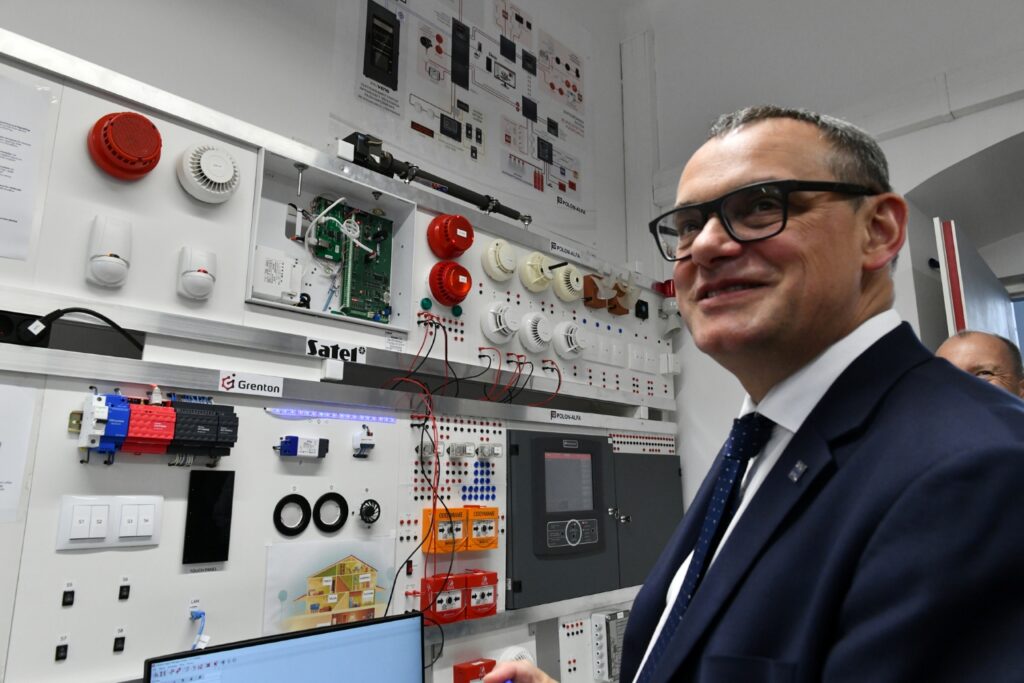
Students of PK Krakow University of Technology (Politechnika Krakowska) have been studying in new teaching laboratories, for stationary robotics and building automation, since the start of the new academic year. They were launched at the Faculty of Electrical and Computer Engineering under the patronage of ABB. Equipped with SAWYER cobots, an ASTORINO robot, and workstations featuring technologies from companies such as NOVUS, SATEL, Grenton and POLON-ALFA, they serve as a practical proving ground for infotronics students. In safe conditions, future engineers get to know solutions from the areas of automation, mechatronics and computer science that they will soon encounter in professional practice.
“The new laboratories give us a much wider scope for educating our students in new building automation solutions and related topics. We are talking about working with machines and solutions used by leading companies. It is a big step forward in the practical education of our students,” says Prof. Maciej Sułowicz, PhD, DSc, Eng., Professor at PK and Dean of the Faculty of Electrical and Computer Engineering.
Stationary robotics within reach of a robotic arm
In the Stationary Robot Automation Laboratory, students learn programming and the operating principles of robotic arms. There are three teaching stations: two with SAWYER robots from Rethink Robotics and a third with the ASTORINO educational robot.
SAWYER robots are cobot-type arms, designed for direct, safe collaboration with humans. “There is no need to create safety zones or a fenced-off area around such robots. Robots of this type are quite student-friendly, because by design they are adapted to working alongside people,” stresses Kacper Hatłas, MSc, Eng., assistant in the Department of Infotronics and Cybersecurity at the Faculty (though the stations are still equipped with safety buttons). The cobots come with kits for building multifunctional, modular end effectors. This allows students to create their own end effector for the arm, which is then used to carry out a task set for them in class.
The ASTORINO educational robot is intended for teaching the basics of industrial robotics. The station includes the robot with a mounting plate, a complete control system, grippers with a compressor and power supply, and dedicated software for visualization and programming. ASTORINO is programmed using AS Language, C++, Python, C# and Blockly.
The system supports USB/Ethernet communication, the Modbus TCP protocol, and the use of an input/output module. The station is also equipped with solutions that increase work safety, including an emergency button and collision detection using an accelerometer. The robot can work with additional equipment, including grippers, a vision system, a conveyor belt and a block feeder, which makes it possible to carry out exercises that reproduce selected industrial processes, including pick & place applications.
Building automation for safety and energy efficiency
In the Building Automation Laboratory, students learn the fundamentals of the technology, the control software, and the principles of designing systems used for the automatic control and management of buildings. “At our new teaching stations, we have gathered the technologies of leading companies specializing in modern solutions for ensuring the safety and security of facilities and their users, economical use of energy, intelligent management of home devices, monitoring and access control,” explains Kacper Hatłas, MSc, Eng.
The laboratory has been equipped with stations from POLON-ALFA, SATEL, Grenton, Novus, DSC and KaDe, as well as the KNX standard from ABB. This allows students to learn the fundamentals of the technologies, the control software, and the principles of designing them.
- The POLON-ALFA station enables hands-on familiarization with the elements of fire protection systems.
- The SATEL station enables students to learn the structure, configuration and operating principles of burglary and robbery alarm systems and their actuating and communication components.
- The Grenton station is intended for practical learning of the design, configuration and programming of building automation systems (smart homes), covering, for example, control of lighting or roller blinds.
- The NOVUS station is intended for practical learning of topics related to closed-circuit television (CCTV) systems, image recording and access control.
- The DSC station, presented with devices from the offer of AAT SYSTEMY BEZPIECZEŃSTWA sp. z o.o., covers solutions for building hybrid alarm systems.
- The KaDe station, also from the offer of AAT SYSTEMY BEZPIECZEŃSTWA, covers solutions for implementing and demonstrating access control systems, such as proximity card readers or electric locks.
- The KNX station is intended for practical configuration, programming and communication of building automation devices that use the KNX standard.
“The adopted solutions are aimed at giving students direct and safe contact with real devices, control software and solutions used in practice. Using technologies from different manufacturers allows us to present students with diverse technical solutions and to develop practical skills related to the programming, configuration, integration and operation of automation and robotics systems,” sums up Kacper Hatłas, MSc, Eng.
Further development of the laboratories is planned. The new teaching tools are to include an integration station based on VENO technology and a station using LOXONE technology. The robotics laboratory, in turn, will be enriched with a KUKA arm and a robot using AMR technology. “The development of this infrastructure will allow us to further broaden the scope of practical education in the area of infotronics,” stresses Dean Sułowicz.
Photos: Jan Zych