70th Anniversary of Hungarian Uprising Commemorated at PK Krakow University of Technology
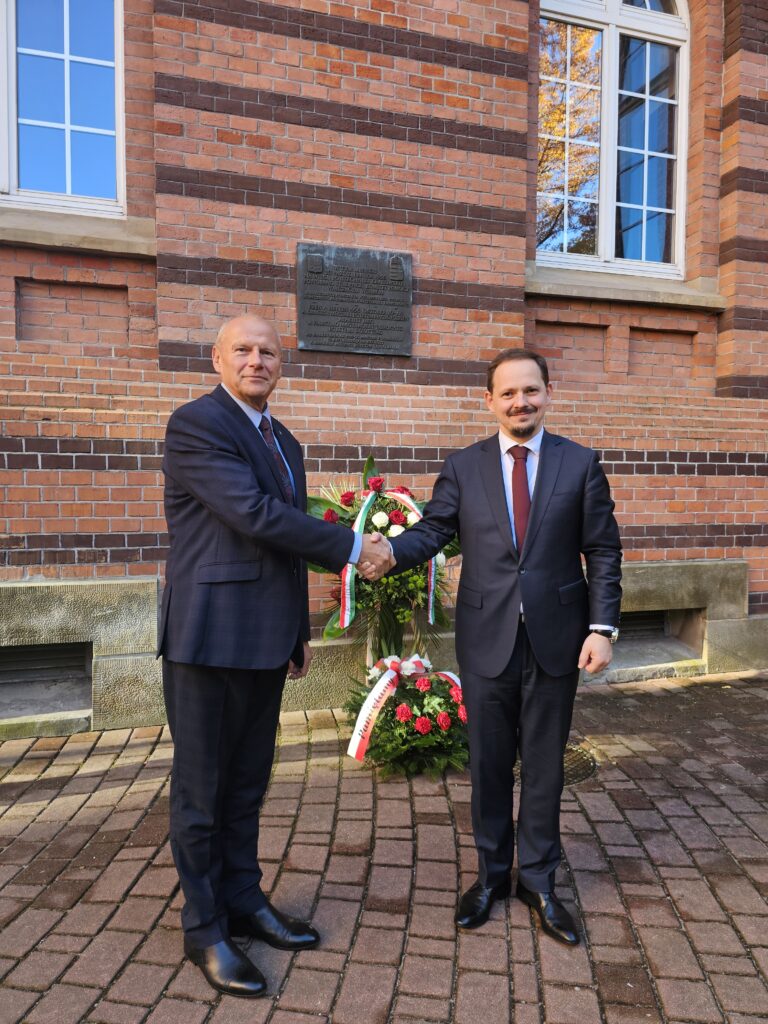
On October 23, on the 70th anniversary of the outbreak of the anti-Soviet uprising in Hungary, at the main campus courtyard of PK Krakow University of Technology at ul. Warszawska 24, the Vice-Rector for General Affairs, Professor Tomasz Kapecki, dr hab. inż. arch., and Dr. Tibor Gerencsér, Consul General of Hungary in Krakow, laid flowers at the plaque commemorating the establishment of the Student Committee for Aid to Fighting Hungarians. The University of Technology was the first university in Krakow to support the Hungarian uprising against Soviet domination in 1956.
In 2006, a plaque – written in Polish and Hungarian – commemorating the events of years past was unveiled on the building of the Krakow university. Every year on October 23, representatives of PK Krakow University of Technology and Hungary lay flowers beneath it.
The beginning of the Hungarian uprising, also known as the Hungarian Revolution, was a student rally in Budapest convened on October 23, 1956. Its participants expressed solidarity with the events of the Polish Poznań June – a workers’ protest brutally suppressed by communist authorities – as well as the changes at the top of the Polish People’s Republic’s government in the following months. The students gathered in Budapest demanded a complete change of the system: freedom of speech, free elections, and independence from the USSR. Crowds of Hungarians joined the student demonstration. In the following days, the uprising spread to other cities, a general strike began, and workers’ councils and independent newspapers started to emerge.
At the same time, Soviet troops, supported by tanks, entered Budapest, and the Hungarian security service AVH opened fire on protesters, killing 100 people. János Kádár became the head of the ruling party, and the new prime minister, Imre Nagy, withdrew consent for Soviet intervention – the military action was halted, and Soviet troops withdrew from Budapest. On November 1, the Hungarian government declared neutrality and withdrawal from the Warsaw Pact, as a result of which the Soviets decided on armed intervention. On November 4, nearly 60,000 Soviet soldiers, using armored vehicles, moved to suppress the uprising. Buildings occupied by the insurgents were recaptured. The fighting lasted until November 10. During the Hungarian uprising, 2,500 people died, over 20,000 were arrested or interned, and approximately 200,000 fled to Austria and Yugoslavia.
During these dramatic events, Poles showed solidarity with Hungarians fighting for freedom. On October 30, 1956, several hundred students and academic staff gathered in the courtyard of PK Krakow University of Technology. During the rally, a letter was read from students of the University of Technology in Civil Engineering and Transport in Szolnok – a partner of PK Krakow University of Technology. It informed about the events in Hungary. The participants loudly demonstrated solidarity with Hungary, and a moment of silence honored the memory of the fallen. The Student Committee for Aid to Fighting Hungarians was then established. Some of its members were already active in the Student Revolutionary Committee at Cracow University of Technology, which played a significant role in Krakow at the time. On the same day, similar initiatives appeared at other universities, and their representatives joined those selected at the university, forming the Student Committee for Aid to Hungarians, with its main headquarters at PK KUT.
(bk)
Pictured, from left: Vice-Rector for General Affairs of Cracow University of Technology, Professor Tomasz Kapecki, dr hab. inż arch., and Consul General of Hungary in Krakow, Dr. Tibor Gerencsér / Photo: Michał Dzikowski