PK Krakow University of Technology Inventors Win a Prestigious International Award
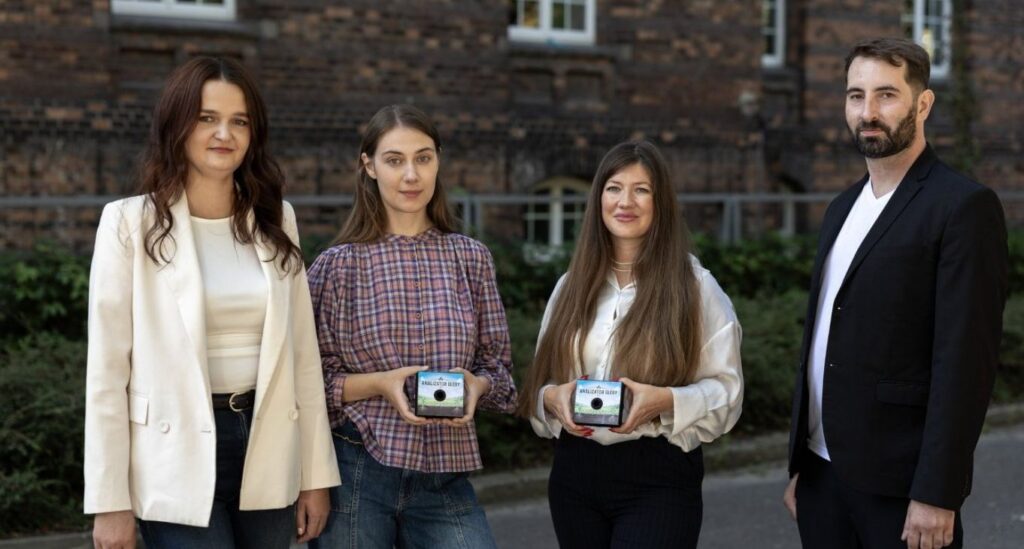
A team of inventors from PK Krakow University of Technology has won the national round of the James Dyson Award. Łukasz Janus, PhD, Eng., Julia Radwan-Pragłowska, PhD, Eng., Aleksandra Sierakowska-Byczek, and Klaudia Kuźmiak developed AgroSysIT — an innovative, portable device for soil analysis. It’s a mini-laboratory that quickly determines pH, nutrient levels, and selected soil contaminants, replacing slow laboratory testing and subjective field checks with a fast, quantitative result that helps farmers precisely match fertilization to their land’s actual needs.
Why soil testing needs a rethink
The inventors wanted to solve two converging issues: soil degradation caused by excessive and poorly-targeted fertilization, and the growing threat of a food crisis driven by climate change. “We need fast, reliable data to reduce fertilizer use without cutting yields. The aim was to build an accessible tool that supports precise decisions, protects soil and water, and strengthens food security,” says Łukasz Janus, PhD, Eng., from the Faculty of Chemical Engineering and Technology at PK KUT.
AgroSysIT fills the gap between simple field tests and expensive laboratory equipment. Most field tests rely on visual color comparison and only give approximate results, while portable NIR devices estimate soil properties indirectly and require complex calibration. “Our system performs direct chemical measurements using absorbance and fluorescence in a single compact device,” explainsJulia Radwan-Pragłowska, PhD, Eng., also from our Faculty of Chemical Engineering and Technology.
How does it work?
The user needs to mix a soil sample with a reagent, place the liquid in a central cuvette, and simply start the test. LEDs and detectors arranged around the cuvette create multiple optical paths, each LED emitting light at a wavelength matched to a specific chemical reaction. The device measures the amount of light passing through the sample to determine absorbance, or detects fluorescence at a 90° angle for substances present at lower concentrations. Rotating the cuvette by 45° enables additional measurement paths without complex optical components. The electronics activate the right LED and detector, minimize interference, and convert the signal using calibration curves. Results are sent directly to an app, tagged to the sample’s collection location, and displayed as data on pH, nutrients, and selected soil contaminants. This solution allows you to quickly choose the right type and amount of fertilizer, cut fertilization costs, and protect soil and water from excessive strain.
Portability, low cost, and precision
The team began by defining key requirements: portability, low cost, repeatable optical geometry, and the ability to measure both absorbance and fluorescence in a single device. The enclosure, central cuvette holder, and radial optical channels were designed in CAD software. Several variants were evaluated digitally, then produced using FDM 3D printing. The device was tested with model dye and fluorescent solutions, benchmarked against a classic UV-Vis spectrophotometer and a laboratory spectrofluorometer. Based on these results, the team refined cuvette positioning, reduced the impact of external light, and improved the emitter-detector layout. They developed a control application for the Arduino board, plus a second Python application (using the Tkinter library) that converts the signal into concentration or pH values using calibration curves. “We also built an app that helps you to choose the right type and amount of fertilizer for a specific field. You just enter the field’s area in hectares, and based on the soil sample analysis, the app calculates how much fertilizer is needed — and even recommends which product to buy,” says Julia Radwan-Pragłowska.
Ready for the market
AgroSysIT is protected by a patent application and ready for commercialization. “Winning the James Dyson Award gives us a chance to reach business partners and investors. We want to keep developing the device and app, expand patent protection, and run tests in real-world conditions,” says Aleksandra Sierakowska-Byczek from PK KUT’s Doctoral School, co-author of the solution. “Our goal is to launch a spin-off at PK Krakow University of Technology and bring AgroSysIT to market as an affordable, easy-to-use tool for precision agriculture. We believe this can help farmers increase the profitability of their production while reducing fertilization’s environmental impact.”The system could also be developed for dual-use applications – for example, for military use in assessing soil contamination.
A national win, followed by an international stage
For winning the national round of the James Dyson Award, the AgroSysIT team received a prize of 24,360 PLN and qualified for the international stage of the competition. They’ll be joined there by Poland’s two other national laureates: Sebastian Górecki, with his beehive-monitoring invention (Intelligent Hives – BeeHUB), and Jakub Cichoń and Natalia Rzadek, with their telescopic walker project (TS Walker). The James Dyson Award is an international design competition for young engineers and designers, run in 28 countries and regions by the James Dyson Foundation. From the national winners, a panel of Dyson engineers selects an international shortlist of 20 inventions. Sir James Dyson then reviews the top 20 projects and selects the international winners, who receive a prize of £30,000.
The project “An intelligent soil fertility assessment system based on advanced photoactive systems coupled with a mobile device as an innovative platform supporting individual farming activities” is carried out under the Lider XIII programme, grant no. LIDER13/0249/2022, funded by the National Centre for Research and Development (NAWA). Read more about the project at www.agrosysit.pl.
(Marcin Bielowicz)
Photo credit: Bartosz Pniewski