Three-wheeled Scooter for People With Disabilities Breaks Down Barriers
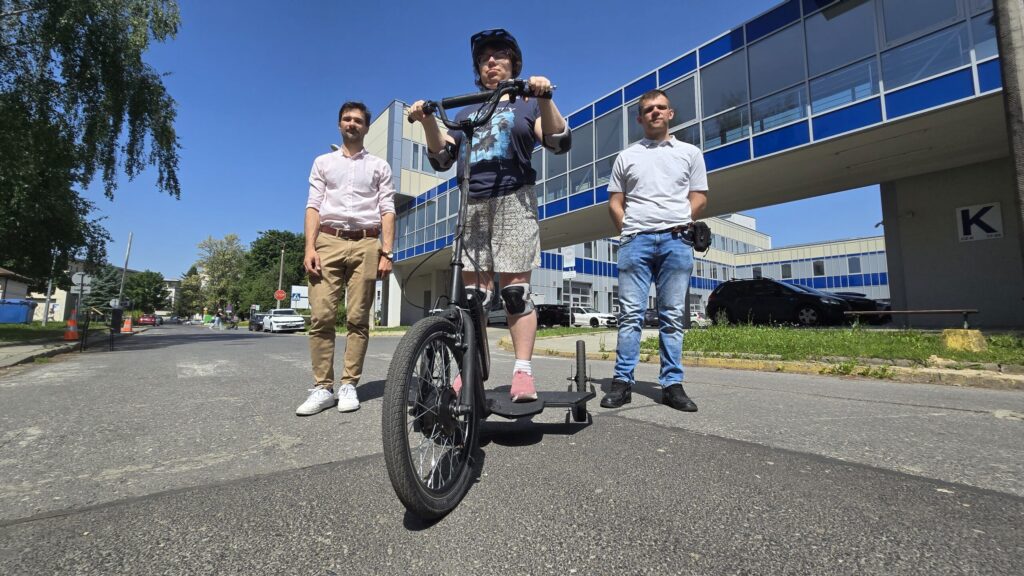
PK Krakow University of Technology student Kamil Guśtak has designed a unique electric scooter. Thanks to its stable, three-wheeled construction, it can facilitate daily mobility for people with motor disabilities and balance disorders. The design was created at the Faculty of Mechanical Engineering at PK KUT as part of a master’s thesis in automotive engineering. It is a response to the needs of a specific user, Sara Wisniewski, a student of automation and robotics at CUT, who lives with cerebral palsy. The prototype has already undergone numerous successful tests with the user’s participation.
– We wanted to create a design that responds to the real needs of the user, not just replicates existing solutions. This is a highly practical project, based on experience and consultations. Within one semester, we managed to develop several concepts, create models and prototypes that allowed us to test individual solutions. Due to the need for individualization and maintaining the highest safety standards, tests with user participation were conducted multiple times – emphasizes Kamil Guśtak, the vehicle’s creator.
Stable and safe engineering design for everyday needs
The vehicle’s three-wheeled configuration ensures greater handling stability, and its parameters have been adapted to Polish legal guidelines for electric scooters. Maximum speed has been limited to 20 km/h, and range on a single charge – according to initial estimates – is 40 to 45 kilometers. During tests on campus surfaces, the primary focus was on vehicle stability, user position ergonomics, and the design’s behavior during maneuvering. For safety reasons, test speed was limited to 5 km/h. For Sara, who currently walks at approximately 1.3 km/h, the ability to increase mobility represents a huge step toward greater independence.
– Most three-wheelers available on the market require body balancing during turning and riding. For people with balance disorders, this is often a huge barrier that prevents them from independently using such solutions. I was looking for something that would be not only stable, but also intuitive to operate and safe – explains Sara Wisniewski, who personally participated in the trials, testing the design’s ergonomics and maneuverability.
The idea for the vehicle was born several years ago, when Sara approached the Department of Automotive Vehicles with a general concept for a device that would facilitate her daily functioning. Initially, other teams worked on the project, and the concept gradually evolved. The breakthrough came in 2025, when Sara came under the supervision of Dr. Eng. Krzysztof Weigel-Milleret, a specialist from the Department of Automotive Vehicles, who had previously provided substantive oversight for the construction of the four-wheeled vehicle for people with disabilities “Lizard”. He proposed this topic to Kamil Guśtak for his master’s thesis. The result was a prototype vehicle that combines engineering knowledge with authentic, everyday user needs.
Dr. Eng. Krzysztof Weigel-Milleret emphasizes that such designs are practically nonexistent on the market today. – We see enormous space for further development of the project and its potential use by people who need stable and safe means of individual mobility. We are at the development stage, but initial tests show that the chosen direction is correct – he points out.
Long tradition of vehicles for people with disabilities at PK Krakow University of Technology
The three-wheeled scooter is not the first design dedicated to people with special needs created at Kraków University of Technology. At the Faculty of Mechanical Engineering, the first such projects were developed as early as the 1960s and 1970s. With the participation of PK KUT specialists, the famous “Gacek” from the Communications Equipment Factory in Świdnik was designed, among others. Later, solutions dedicated to people with disabilities were developed by Prof. Witold Grzegożek with successive teams of collaborators and students (their designs included Buzz, among others). Currently, the most intensively developed project at CUT is “Lizard” – an electric four-wheeler for people using wheelchairs (created by Bartłomiej Romowicz and Adrian Starowicz).
Now the three-wheeled scooter has joined the family of university vehicles with a social purpose. Like its predecessors, it demonstrates how engineering can genuinely change the everyday lives of people with disabilities. The creators of the three-wheeled prototype do not rule out that after refining the technology, the vehicle could reach wider use, and perhaps even commercialization. Although the scooter was created for a specific user, it is based on solutions that could also be useful for other people with mobility difficulties. However, the path to such broad application of the student idea is not simple – it leads from the stage of complete documentation to preparation of production technology, and above all requires investor support.
(as, j, m)