Innovative COMET Planetary Rover by PK KUT students
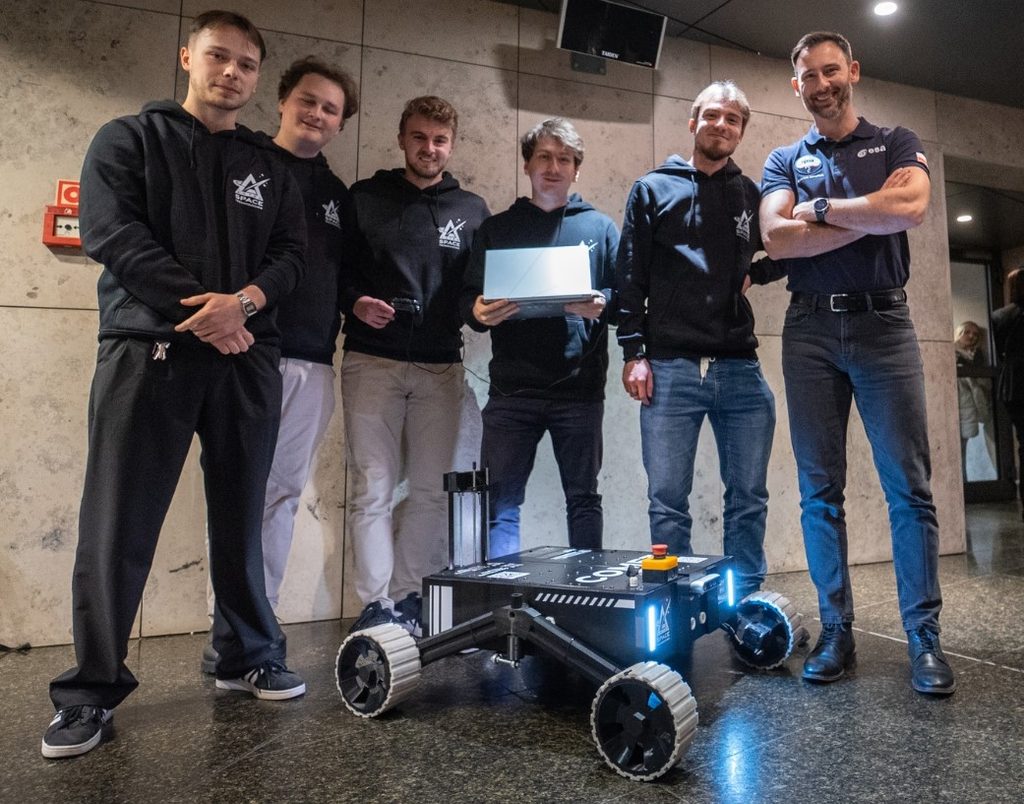
Students from PK KUT are developing the “COMET” planetary rover, a versatile machine designed for reconnaissance, research, rescue, construction, military, and delivery tasks. This operational mobile robot is the creation of the university’s interdisciplinary Astro Space Technologies student research group and is currently undergoing advanced testing. Built to last and handle any scenario, it is being rigorously tested in various terrain and atmospheric conditions. The multi-purpose vehicle also aims to compete against similar machines at prestigious rover competitions, including the European Rover Challenge in 2026.
COMET is an autonomous, research-oriented planetary rover—an operational mobile robot designed for reconnaissance, specialised, and servicing missions. “We are designing our construction to be as modular and modifiable as possible, allowing for the addition of modules with various applications,” explains Krzysztof Periy, leader of Astro Space Technologies PK and a PhD student at the Faculty of Electrical and Computer Engineering. “These will include a 6-degree-of-freedom gripper, a deep-sample drill, a vision system, a communication system, a drone landing pad, a chemical laboratory, and a storage unit for collected samples. We aim for the highest quality of components and the IT system, and we are also working towards the robot’s full autonomy.”
The 18-person construction team includes students and staff from four PK faculties: Faculty of Electrical and Computer Engineering; Computer Science and Mathematics; Mechanical Engineering; and Materials Science and Physics. This interdisciplinary collaboration is guided by experienced university scientists. The core team consists of both graduate students and undergraduates specialising in fields like computer science, automation, electronics, mechanical engineering, and physics.
Drone + Rover = Specialized Robot System
The rover is a remotely controlled, four-wheeled mobile platform equipped with a vision system and a set of environmental sensors. “Its design allows for reconnaissance, terrain inspection, and transport of light cargo in difficult conditions,” says Periy. “Thanks to its high-travel suspension, high ground clearance, and independent drive control, the rover can move stably over uneven ground and manoeuvre precisely in confined spaces.”
The project includes a docking platform for a reconnaissance drone, which will ultimately support aerial terrain analysis. A drone constructed by the team will soon be fully integrated with the rover, creating a two-module system of cooperating robots. “The rover will receive real-time topographic and environmental data, as well as dynamic obstacle maps created from ‘bird’s-eye view’ imagery. This will significantly increase the effectiveness of autonomous navigation and operational safety,” adds the team leader. The drone will be equipped with a communication system for autonomous takeoff, landing, and direct transmission of terrain maps to the rover’s onboard computer.
Future development stages plan to equip the machine with an advanced 6-degree-of-freedom manipulator (gripper), enabling precise tasks like e.g. lifting/sorting objects, operating technical panels, and, naturally, collecting samples. A parallel development is a sample storage module—a set of secure containers for safe geological sample transport. The team is also upgrading the sampling system to collect surface material and drill to shallow depths, complemented by a weighing system and documentation via photos and basic environmental measurements.
Students are also developing an autonomy module, allowing to navigate a designated route independently, avoid obstacles, and assess terrain conditions based on data from cameras, sensors, and the drone. Consequently, the rover will be ready for increasingly advanced inspection, servicing, and research tasks, with its modular design allowing for future functional expansion.
A Planetary Rover, Because Mars is Not Enough
The max speed achieved during tests is approx. 20 km/h, but this is not its upper limit. The drone can fly at speeds up to 150 km/h. COMET has a 4-wheel electric BLDC motor drive. On one battery pack at maximum RPM, it can operate for about 1.5 hours. It currently uses an 18V industrial battery; it is possible to extend its operational time with additional packs. It weighs about 20 kg, but after mounting all additional modules (drone docking platform, manipulator), it will roughly double in weight (with dimensions of 80 cm W, 95 cm L, 30 cm H). The drone measures 55×50 cm.
Hubert Orlicki from Astro Space Technologies discussed the onboard systems: “The rover currently uses an ATmega256 AVR family microcontroller for low-level control and sensor handling. Tasks requiring greater computational power, like image processing and camera data analysis, are handled by a separate Linux-based onboard computer with an AMD Ryzen™ 5 processor and an RTX 4050 graphics card for machine vision acceleration.”
The control is facilitated by proprietary software allowing operation via computer keyboard or a controller with joysticks. Communication currently uses an industrial router with a 150m range, but the team is working on a new radio-based system in order to increase operational distance even more. COMET has been tested in desert (Błędowska Desert, the only one in Poland), muddy, clay, and forest terrain. “It performed well during tests, but after each, we added minor mechanical improvements to strengthen the structure,” says Kamil Kaczmarz from Astro Space Technologies, a PhD student at the Faculty of Mechanical Engineering.
“We aim for a fully waterproof robot, so wet condition tests for missions in rain and snow are expected. We might also adapt the drive to something akin to a snowmobile track for winter operations.” The constructors underline the rover’s wide range of potential applications: military reconnaissance, courier vehicle, reconnaissance in dangerous areas, or an educational machine. This broad spectrum is the reason why its creators prefer the term “planetary rover” over the common “Martian rover.” This also stems from the fact that Earth conditions significantly differ from Mars, which has harmful radiation, different atmospheric pressure, temperatures, and gravity, to name a few.
“After building a fully functional prototype with all planned features adapted for Earth conditions, we intend to modify it to be resistant to extraterrestrial conditions and operate in such environments,” adds Krzysztof Periy.
Per Aspera Ad Astra
Rovers used in actual space missions by agencies like NASA or ESA incorporate cutting-edge technologies and software. While student projects cannot compete with those backed by giant budgets, student competitions like the European Rover Challenge (ERC) often serve as a gateway into the space industry. Their juries include specialists from space agencies and the industry who can easily spot and appreciate talent and creativity. The COMET team is currently preparing to participate in the European Rover Challenge 2026 finals, scheduled for 4-6 September 2026, at the AGH University of Krakow. Qualifying for the finals requires submitting detailed technical reports in English and a presentation video. The competition is tough, with only about one-fifth of approximately 100 global teams advancing.
“We have submitted our construction for evaluation in the last two ERC editions and came close to the finals last year. Based on the knowledge gained, we have completely redesigned the project. We believe qualifying and securing a spot in the ERC final is within our reach,” adds Periy.
But their ambitions extend beyond ERC 2026. “We also plan to enter the Anatolian Rover Challenge in Turkey. Additionally, we aim to apply for the University Rover Challenge 2027 in the USA, held in the Utah desert. Qualifying for such competitions, where the robot must be prepared for terrain conditions somewhat similar to Mars, would open many opportunities for us in the space industry,” announces Mateusz Raźny. COMET has already been showcased at scientific events. On 4 November 2025, the team participated in the “Space for Everyone” event at Jagiellonian University, where astronaut Sławosz Uznański-Wiśniewski showed interest in their work. Their inventions were also presented at the “Science and Business” congress in Warsaw and the inaugural CogiTECHon Innovation Festival.
Space Technologies at PK Krakow University of Technology
The COMET planetary rover is yet another example of growing student activity in space technologies at PK KUT in recent years. Since 2023, students from the COSMO PK student research group have successfully launched the HABSat stratospheric probe on missions to study cosmic radiation intensity at different flight altitudes.
In March 2024, students from this circle implemented the “pharmaCOSMOGEL” project on lyophilized hydrogel dressings as a potential treatment for skin wounds and mucous membrane inflammation in astronauts. The team became finalists in the “Direction: Space” competition organised with the European Space Agency.
Earlier this year, Kacper Odziomek, a PK KUT biotechnology student, became the only Pole to join the prestigious American “Andromeda” programme, where he is developing methods to counteract bone demineralisation in astronauts under microgravity conditions.
(jp)
Photo: Robert Żewecki
Translation: Marcin Bielowicz