Prestigious Horizon Europe Grant for PK Krakow University of Technology
Researchers from PK KUT will lead an international consortium that has been awarded funding under the prestigious Horizon Europe programme, within the Marie Skłodowska-Curie Actions (MSCA) scheme. Scientists from four continents and nine countries will collaborate on the project Hypercomplex Explainable AI: Mathematical Foundations for Trustworthy Models (HyperXAI), focusing on the development of theoretical frameworks for explainable artificial intelligence (XAI).
The innovative research, coordinated by researchers from the Faculty of Computer Science and Mathematics, moves beyond standard AI models operating in the field of real numbers and instead explores higher-order algebraic structures, including complex numbers, quaternions and Clifford algebras. The results may help shape the future development of AI-based technologies in fields such as medicine, industry, materials engineering and energy, while contributing to the creation of AI systems that are safe, transparent and socially acceptable.
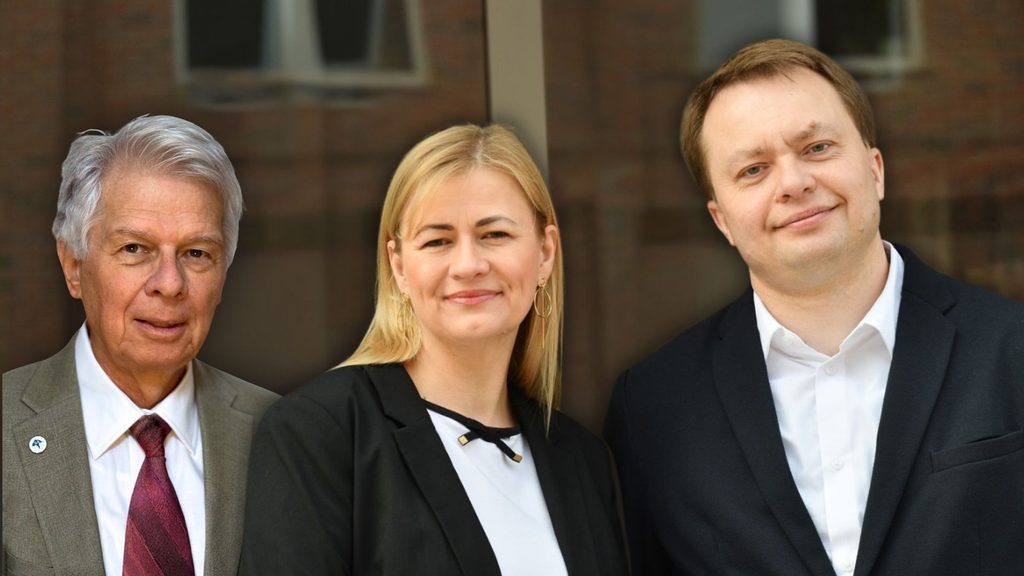
The project Hypercomplex Explainable AI: Mathematical Foundations for Trustworthy Models (HyperXAI) received over EUR 870,000 in funding and an excellent evaluation score of 94.8%, placing CUT among the leading institutions coordinating cutting-edge research on the transparency and reliability of machine learning algorithms. The project is coordinated by Agnieszka Niemczynowicz, PhD, from the Faculty of Computer Science and Mathematics and is conducted within the Mathematics for Computer Science and Applications (M4CSA) research group, led by Radosław Kycia, PhD. The grant team includes Agnieszka Niemczynowicz, PhD, Radosław Kycia, PhD, and Prof. Martin Ostoja-Starzewski, all from the Faculty of Computer Science and Mathematics.
Introducing a new paradigm: Hypercomplex neural networks
Artificial intelligence is increasingly used to support decision-making in healthcare, energy systems, and security. Despite their growing effectiveness, many AI models remain insufficiently transparent. While explainability methods exist for classical, real-valued AI models, hypercomplex neural networks remain largely outside this mainstream.
“Hypercomplex neural networks represent one of the most innovative directions in contemporary AI research,” explains Agnieszka Niemczynowicz, PhD, project leader. “They rely on advanced mathematical structures that allow for the natural modelling of multidimensional and geometric relationships, often with greater computational efficiency than classical neural networks. At the same time, there are currently no established theoretical frameworks or dedicated explainability metrics for such models.”
The absence of formal explainability frameworks makes hypercomplex models difficult to control and verify, despite their significant potential. HyperXAI addresses this gap by developing mathematically rigorous foundations for explainability at the intersection of mathematics and computer science. As a result, explainability becomes a core design principle for next-generation AI systems.
From fundamental research to real-world impact
The HyperXAI project focuses on fundamental research, aiming to establish solid mathematical foundations for explainability in advanced AI models. The outcomes of the project will support the responsible use of hypercomplex neural networks in applications involving complex, multidimensional data, including medical imaging, biomedical signal analysis, materials science, industrial process monitoring and energy systems. In these areas, understanding which data features influence algorithmic decisions is essential. The project will lead to the development of new scientific tools, including analytical methods and quality metrics for explanations and evaluation protocols, enabling systematic comparison of models and their interpretability. Thanks to the open nature of the tools, datasets and software developed within HyperXAI, they will be available for further use and development by research teams worldwide.
Global and interdisciplinary scientific collaboration
HyperXAI is implemented by an interdisciplinary international consortium led by PK Krakow University of Technology and involving institutions from Poland, Spain, the Czech Republic, Latvia, Azerbaijan, Turkey, Iraq, South Korea, and Brazil.
“The challenge of explainable AI, especially in the context of hypercomplex neural networks, cannot be addressed within a single discipline,” notes Kycia, PhD. The project brings together experts in pure and applied mathematics, computer science and machine learning, as well as engineering disciplines, ensuring that theory, algorithms and application contexts evolve in parallel. As emphasised by Prof. Ostoja-Starzewski, interdisciplinarity is not an addition, but a prerequisite for success: mathematics without computer science would remain theory, computer science without mathematics would rely on heuristics, and both without engineering would lack responsible real-world applicability. HyperXAI brings these perspectives together into a coherent research process in which theory, algorithms and application contexts develop in close interaction.
European funding that drives excellence
The project is funded under the MSCA Staff Exchanges scheme, part of Horizon Europe, the European Union’s flagship programme for research and innovation. According to the European Commission, in the MSCA Staff Exchanges 2025 call, 363 proposals were submitted and 81 were selected for funding. Among them, Cracow University of Technology is one of only three Polish universities coordinating a funded project. The success of HyperXAI builds on earlier interdisciplinary collaborations within the M4CSA group, including projects funded by the Polish National Agency for Academic Exchange (NAWA).
The HyperXAI consortium brings together the following institutions:
- PK Krakow University of Technology (Poland) – project coordinator
- State University of Campinas (Brazil)
- University of Cádiz (Spain)
- University of Málaga (Spain)
- University of Ostrava (Czech Republic)
- Baku State University (Azerbaijan)
- Kocaeli University (Turkey)
- Igdir University (Turkey)
- University of Latvia (Latvia)
- Hanyang University Industry–University Cooperation Foundation (South Korea)
- University of Kufa (Iraq)
- Ankara University (Turkey)