The PK KUT’s “Bloody” Debut in the Juliusz Słowacki Theater’s Extraordinary Production of “Antigone”
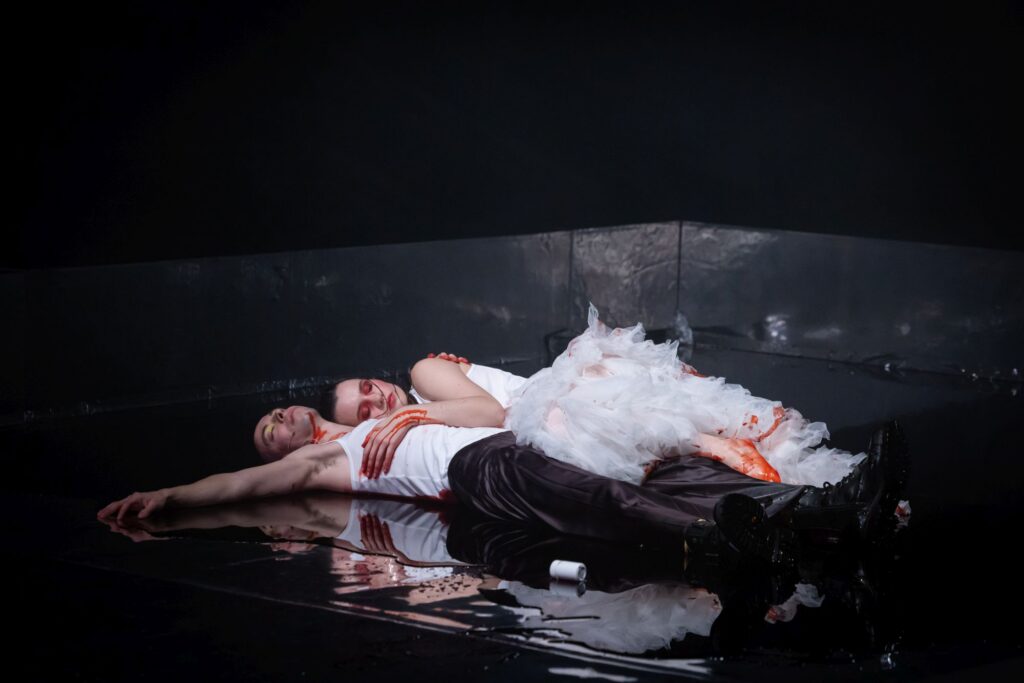
No scientific solution from the PK Kraków University of Technology has ever had such a premiere! Artificial blood produced in the university’s laboratories debuted in the first premiere of the year at the Juliusz Słowacki Theatre in Krakow. In the musical “Antigone” (dir. Jakub Roszkowski), 500 liters of the university’s blood “plays” one of the main roles.
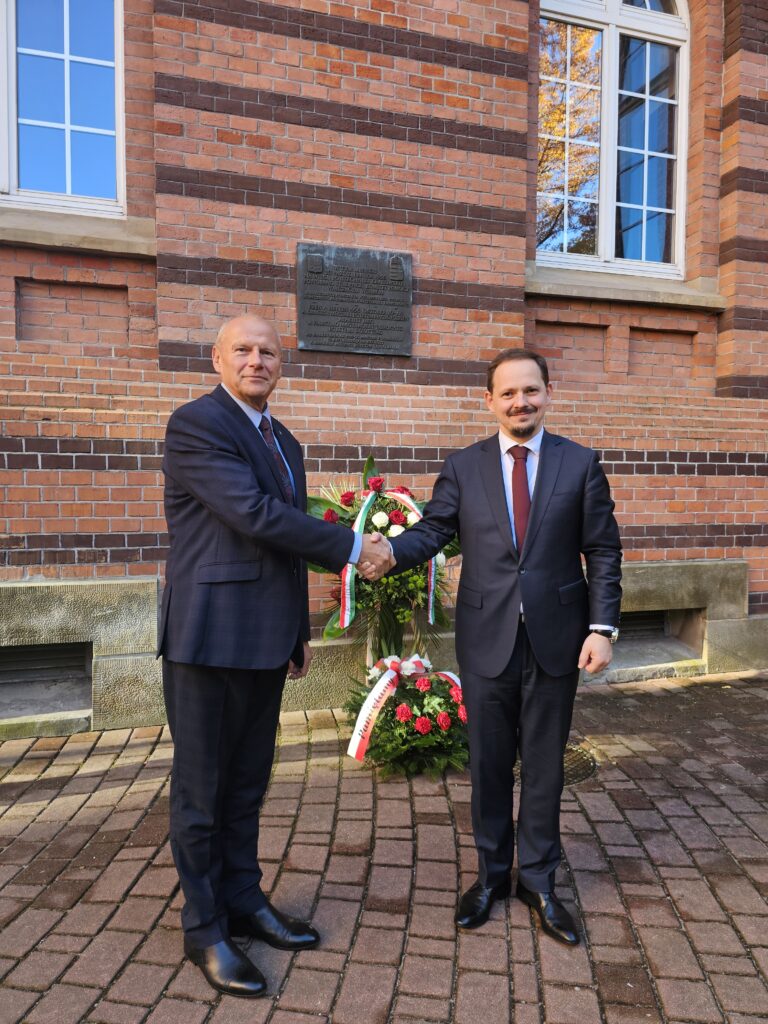
– This is an extraordinary play. Its creators used exceptionally original and bold artistic means of expression, including a set design element uniquely created by us. We are very proud because our chemists so perfectly utilized their engineering craftsmanship to support the artists – says Prof. Andrzej Szarata, Rector of the Kraków University of Technology, after the play’s premiere.
Artists with an unusual task for scientists
Specialists from the Faculty of Chemical Engineering and Technology at the Kraków University of Technology are not afraid of challenges, even the most unusual ones. And it was with such an artistic and technical task that the Juliusz Słowacki Theatre approached the Kraków University of Technology. – We were asked if we could produce artificial blood prepared in such a way as to fulfill the requirements of the play’s script. It could not be the stage blood commonly available on the theatrical props market – says Dr. Eng. Piotr Michorczyk, Dean of the Faculty, one of the creators of the theatrical blood.
Without revealing too many details (so as not to spoil the experience for future audiences), it had to be a substance with special characteristics. – Rheological properties, ensuring, among other things, the flow of the substance as expected by the play’s creators, were to play a significant role. The density of the fluid and the depth of its color were also important. Our “blood” was optimized in terms of these properties to meet the script’s requirements – explains Prof. Piotr Michorczyk.
The details of the project were agreed upon with the producer of the musical “Antigone,” Oliwia Kuc. The requirements included appropriate rheological properties, color, safety for actors, low staining, and durability (for multiple uses). – After establishing the boundary parameters in the first stage, samples of preparations based on pigments and dyes were prepared. We prepared as many as 13 proposals, from which the appropriate color version of the blood was selected – says Prof. Michorczyk.
500 liters of artificial blood in the university’s chemical laboratory
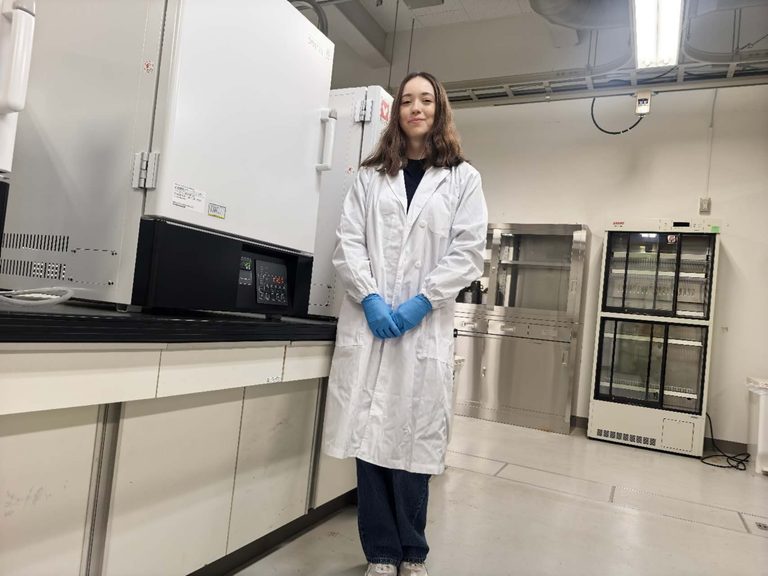
The biggest difficulty in carrying out the task was the enormous scale of the order. The competence of the university’s chemists and the advanced capabilities of its research infrastructure allowed for the relatively quick development of an original formula for the preparation. But preparing first 400 liters of artificial blood, and then another 100 liters ordered by the Theatre, was a significant logistical challenge for a university laboratory, not an industrial one.
– Producing so many liters of stage blood with a homogeneous consistency is not a problem on an industrial scale nowadays. The problem is optimizing its composition for the play, which required us to design the composition from scratch – explains Piotr Michorczyk. – On an industrial scale, 500 liters is too small a production to make it worthwhile to retool production for such an order. At the university, however, scale matters. Most of our research equipment is for a maximum of a few liters. Several hundred liters of production is a challenge.
The university’s chemists therefore had to produce the stage blood simultaneously in four 20-liter tank reactors. – This required us to repeat the procedures 25 times, but also to react appropriately to problems that arose during the work, e.g., the problem with the solubility of some components – says Prof. Michorczyk. The university’s blood is designed for multiple uses and is based exclusively on food-grade products and cosmetics. – They ensure proper rheology, microbiological stability, and color. We used pharmaceutical-grade intermediates – emphasizes the Dean of the Faculty of Chemical Engineering and Technology. The production of such blood is only seemingly a simple technological mixing process. In practice, the process required specialized knowledge and original ingenuity. – It was essential to maintain optimized process parameters, mixing order, and proper proportions – explains the Dean of FCE&T PK KUT.
Specialists from the Department of Organic Chemistry and Technology at the Faculty of Chemical Engineering and Technology of the Kraków University of Technology worked on developing the appropriate consistency and color of the blood. Dr. Eng. Piotr Michorczyk, Prof. PK KUT, designed the stage blood, optimized its composition, and manufacturing technology. Dr. Adam Węgrzynowicz participated in the technological and pre-production stages, and Dr. Eng. Barbara Michorczyk was responsible for rheology and color measurements. Eng. Anna Drabczyk designed the labels for the prop packaging.
“Antigone” – doubly innovative
The stage blood “appears” in key parts of “Antigone.” – The entire play, especially the scenes involving the blood created at the University of Technology, makes an incredible impression – reveals the Rector of the University, who attended the enthusiastically received premiere of the performance.
The musical “Antigone” tells Sophocles’ tragedy in a contemporary, rap language. The Słowacki Theatre emphasizes that its play builds a bridge between the world of ancient heroes, values, and choruses, and the world of today’s young people, whose rebellion and heroism are mixed with confusion, fear, and uncertainty. The play was directed by Jakub Roszkowski. Mirek Kaczmarek is responsible for the set design, costumes, and lighting. The lyrics and music (with Michał Szlempo) were created by Jarosław BISZ Jaruszewski, one of the most important contemporary Polish lyricists and rappers. The innovative approach of the creators of Krakow’s “Antigone” to the classical literary work perfectly harmonizes with the idea of inviting scientists from the University of Technology to realize the performance. The first showings of the musical, which met with an excellent reception from the audience, demonstrated how successful this idea was.
The production of blood for “Antigone” is not an isolated act of cooperation between engineers from the University of Technology and the world of art. – We have a cooperation agreement with the Słowacki Theatre. We know that there are many unusual engineering challenges during the realization of theatrical performances. The Director of the Theatre, Krzysztof Głuchowski, already has new tasks for us, requiring great inventiveness. We do not rule out further joint premieres… – says Rector Andrzej Szarata.
The university’s chemists enjoyed the unusual challenge. – The realization of such orders, of course, takes place when we have time for it. In our research teams, we focus primarily on scientific research and educating students. But we often receive reports of technical and process problems for which there is no standard solution. We then have the opportunity to exercise our engineering ingenuity. Among the unusual tasks, the one from the Juliusz Słowacki Theatre in Krakow was the most demanding in terms of production scale. But we like challenges – concludes Dean Piotr Michorczyk about the theatrical adventure.
(mas, j)