Missing piece of the particle family found at CERN. A world discovery involving PK KUT scientists!
The LHCb experiment team at the European Organization for Nuclear Research (CERN) has, for the first time, reliably observed the Ξcc⁺ baryon, made up of two heavy charm quarks and one down quark. Physicists had predicted its existence for years, but an earlier hint had never been confirmed. The new signal exceeded seven standard deviations. The discovery was made by an international team of more than 1,000 scientists, including researchers from PK Krakow University of Technology! We present the discovery in partnership with the Nauka w Polsce PAP service.
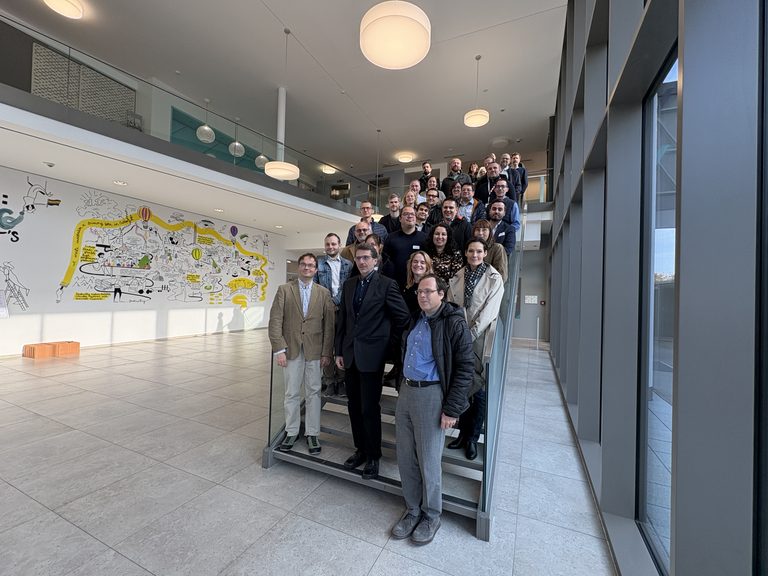
PK KUT researchers in the LHCb experiment at CERN
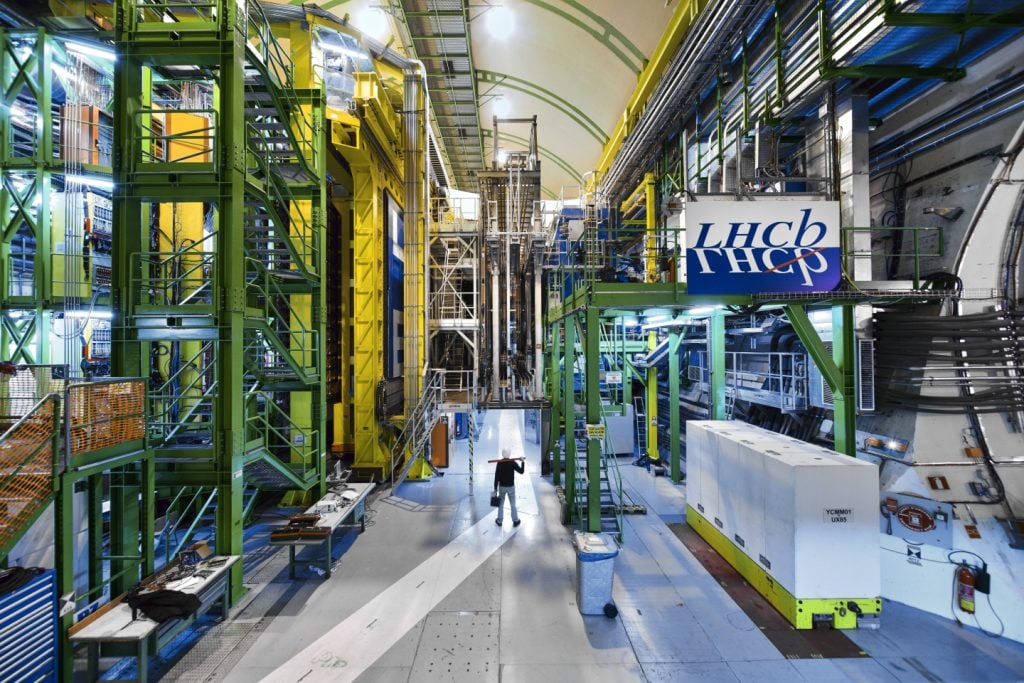
The LHCb (“Large Hadron Collider beauty”) experiment is one of the four main detectors installed at the Large Hadron Collider (LHC), dedicated to research in various areas of particle physics. LHCb specializes in the physics of hadrons containing b quarks (from “beauty”) and c quarks (from “charm”), hence its name (with a lowercase “b” in LHCb).
PK KUT has been a member of LHCb as a so-called Associate Member since 2021. Our researchers working in the LHCb experiment team at CERN include: Dr. Sebastian Kubis, PK KUT Professor (team leader), Dr. Maciej Duras, and Dr. Józef Borsuk from the Faculty of Materials Engineering and Physics at PK KUT, as well as Prof. Piotr Duda and Dr. Łukasz Felkowski from the Faculty of Mechanical Engineering at PK KUT.
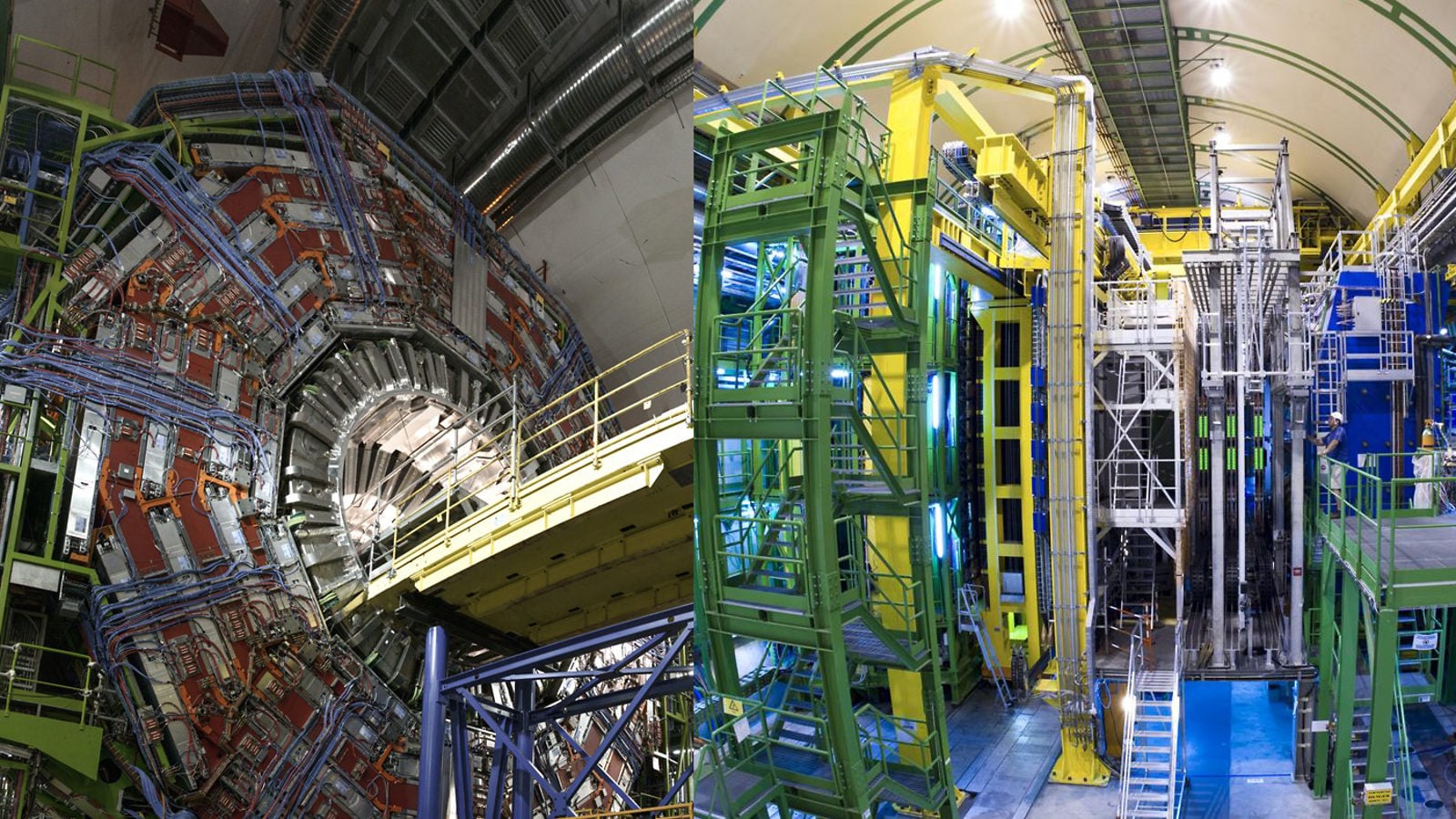
The latter two are involved in developing the design of the LHCb experiment’s detector. – It’s a complicated engineering task to “pack” detection panels together with advanced electronics and a dense web of fiber optics – everything needs to be cooled and “dismountable” so it can be serviced in case of a failure – says Sebastian Kubis, a theoretical physicist and leader of the PK KUT team at LHCb. He himself, together with colleagues from the Faculty of Materials Engineering and Physics, works on data analysis. – The experiment generates hundreds of terabytes of data – that’s why there are many groups interested in a particular event, such as the production of some rare particle – explains the PK researcher.
All the researchers from PK KUT are co-authors of the paper describing the results of this latest discovery, published in the prestigious scientific journal “Physical Review Letters”. What is it about?
The particle family is now complete
For years, physicists had before them a particle family with a clearly empty slot. In 2017, the LHCb experiment led to the discovery of the Ξcc⁺⁺ baryon. According to theory, it should have a close partner – a particle called Ξcc⁺ with almost the same mass. Searches, however, yielded at most weak traces. Now the empty slot has finally been filled.
Baryons are particles made up of three quarks. This group includes protons and neutrons, which differ by only one of their three components. The two types of quarks found in them are called, by physicists, “up” and “down” – purely conventional names that do not describe position or direction of motion. A proton contains two up quarks and one down quark, while a neutron contains one up quark and two down quarks. A similar difference occurs in the pair studied by LHCb. Ξcc⁺⁺ consists of two charm quarks and one up quark, while Ξcc⁺ consists of two charm quarks and one down quark. “Charm” is likewise just the historical name for one of the six quark flavors. The charm quark is much heavier than the quarks that make up protons and neutrons, and it decays quickly. Particles containing two such quarks form rarely and have extremely short lifetimes. Ξcc⁺ likely disappears much faster than a trillionth of a second – far too quickly to reach the detector.
The search therefore resembles reconstructing an event from the fragments left behind. Ξcc⁺ decays into several other particles, which LHCb records. In the case analyzed, the end products were a proton, two kaons, and two pions. The detector measured their tracks and momenta, and scientists checked which of them could have previously formed a single heavier object. If particles are grouped together randomly, the calculated masses of the combinations are scattered. If many combinations come from the decay of the same baryon, a cluster appears on the graph. Exactly such a trace appeared in the data collected in 2024. It matched a particle with a mass of about 3,620 MeV/c², nearly four times the mass of a proton. The analysis indicated around 915 Ξcc⁺ decays.
This was not the first lead. The SELEX experiment conducted in the United States had already reported a possible detection of Ξcc⁺ back in 2002–2005, but the mass indicated at the time was about 101 MeV/c² lower. Other experiments failed to confirm this result. A small excess of events also appeared in earlier LHCb data, but it was too weak to be considered a discovery.
Only data collected after the detector’s upgrade made it possible to resolve the puzzle. The reliability of the new signal exceeded seven standard deviations, meaning it is extremely difficult to explain it as a random fluctuation of background noise. Particle physicists require five standard deviations before considering the existence of a new particle confirmed. This time, the result clearly surpassed that threshold. A weaker but consistent trace was also found in older data from 2016–2018. The central result indicates that Ξcc⁺ is about 1.8 MeV/c² lighter than its partner Ξcc⁺⁺, as theorists had expected.
The exact difference remains uncertain, however, since the new particle’s lifetime has not yet been measured. This determines how far it can travel before decaying and which events the detector is able to capture. Solving one puzzle has thus immediately opened up another.
From CERN to medicine, the Internet, and many other practical applications
The discovery of Ξcc⁺ gives physicists a rare opportunity to study a system in which two heavy quarks sit alongside one light quark. By comparing these nearly twin baryons, researchers can examine how swapping a single quark affects the mass and decay of the entire particle. It is a precise test of the theory of the strong interaction, which binds quarks together into protons, neutrons, and other baryons.
– This discovery fills in a missing piece on the current list of elementary particles. Its composition is predicted by the theory of elementary particles known as the Standard Model, which thereby receives further confirmation. On the other hand, at LHCb we hope to find signals of “new physics” – that is, events that go beyond the Standard Model. Our group is currently analyzing the decay of the B⁰ₛ meson, which contains a “b” (beauty) quark and an “s” (strange) quark. In a previous analysis, based on older data, a certain discrepancy with theory appeared; we now want to use the latest data collected during the so-called Run 3, that is, in 2022–25. Who knows, maybe we’ll find something? – explains Prof. PK Sebastian Kubis.
The discovery of Ξcc⁺ does not directly lead to a new technology, but the PK KUT researcher stresses that although elementary particle physics may seem far removed from our everyday lives, in the long run its discoveries find practical applications. – Many medical imaging methods rely on knowledge from particle physics – for example, PET scans would not exist if someone hadn’t discovered the positron, the antiparticle of the electron. Earlier, the concept of an antiparticle seemed like a theorist’s fantasy. We now have cancer therapies using precisely focused proton beams. At CERN itself, “knowledge transfer” takes place – solutions related to operating the collider are transferred to industry or other fields of science. This is how the World Wide Web, based on the HTML markup language, came about, revolutionizing the internet and turning it into a tool for everyone. When there wasn’t enough computing power to process huge amounts of data, CERN implemented the idea of a global computing network, the so-called GRID, which could make use of “idle” computers at distant research centers – recalls Prof. Kubis.
Precise radiation detectors developed at CERN are used in microscopy, radiation dosimetry, materials research, and medical devices. – CERN’s cooperation with the medical industry led to the development of color 3D X-ray tomography. CERN also developed advanced software for efficiently processing large amounts of data – it is used wherever Big Data is involved – recalls the PK physicist. Among other solutions that have grown out of scientific research at CERN, it is worth mentioning superconducting magnets, important for the energy sector and for nuclear fusion, as well as the development of cryogenic technologies (the collider’s magnets are cooled with liquid helium).
International collaboration on a massive scale
Research conducted at CERN is exceptional not only for the contribution it makes to global science. It is also an example of scientific collaboration unprecedented in scale – interdisciplinary and multinational. – It really is remarkable how research cooperation among so many people takes place at CERN. In LHCb alone, there are about 1,800 people from various research centers around the world! One might joke that it all works thanks to the Swiss spirit of good organization… But what matters most here is openness to cooperation on the part of the participants in a given project, as well as maintaining discipline in the work undertaken – emphasizes Sebastian Kubis.
He reveals what such cooperation looks like in practice. – Physicists travel to CERN once or twice a year for working conferences or so-called shifts, meaning work on data collection. It’s worth remembering that the detector operates 24 hours a day, continuously for several months, which requires a shift system. We carry out the analysis of already collected data at our own institutions, for example in Kraków – all we need is remote access to the servers at CERN.
Specialists in the construction and reliable maintenance of the collider’s infrastructure more often have the chance to admire it in its full glory. – Now a period of intensive work awaits them. In June this year, the entire collider was shut down and our experiment stopped collecting data. Over the next three years, it will undergo a major upgrade. After the upgrade, it is expected to collect several times more data, and with greater precision – says Prof. Kubis.
In addition to researchers from PK KUT, the study also involved scientists affiliated with the AGH University of Krakow, the Institute of Nuclear Physics of the Polish Academy of Sciences, and the National Centre for Nuclear Research. The paper describing the results, titled“Observation of the Doubly Charmed Baryon Ξ+𝑐𝑐 with the LHCb Run 3 Detector,” published in the prestigious scientific journal “Physical Review Letters,” has an enormous group of co-authors representing 92 affiliations!
Source: Nauka w Polsce PAP and our own – MAS