“Dual Use Technology” – PK KUT’s Zone at the 35th Economic Forum in Karpacz
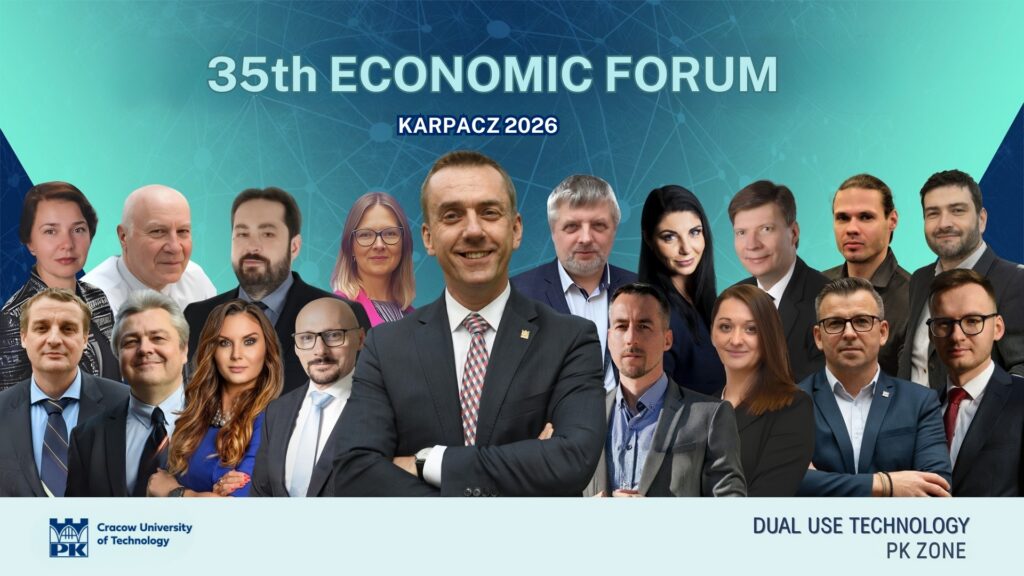
Post-quantum cryptography standards, Europe’s technological sovereignty in a shifting global economic order, and the strategic challenges facing the EU’s semiconductor sector – these are real issues demanding discussion and evidence-based solutions. That is why, once again, PK Krakow University of Technology — its staff and experts, alongside representatives of industry, innovative companies, academia and local government — will play a significant role at the 35th Economic Forum in Karpacz, taking place on 8-10 September. The University serves as Academic Partner of the event. Organizers expect this year’s edition, themed “Architecture of the New Order – Stability in Times of Change,” to draw more than 6,000 guests from around the world. In the University’s own “Dual Use Technology” zone alone, more than 20 activities are planned – panel discussions, 1:1 conversations and other events. As in previous years, CUT will present the “AI Visionary Award” to a company demonstrating innovative use of artificial intelligence. The winner will be announced during the gala closing the second day of the Forum.
Highlights of the zone’s program, among others, include:
✅ “Sovereignty in the Shadow of Qubits: Do We Need Our Own Post-Quantum Standards?” — moderated by Grzegorz Gancarzewicz, PhD
✅ “Europe’s Technological Sovereignty – Are We Ready for a New Economic Order?” — moderated by DSc Eng. Bożena Tyliszczak, prof. PK
✅ “The Semiconductor Sector in the European Union – Innovation, Expertise, and Strategic Challenges” — moderated by DSc Eng. Katarzyna Matras-Postołek, prof. PK

Eight thematic tracks, one university zone
The motto of the 35th Economic Forum in Karpacz sets the main thematic axis, around which events in eight leading program areas will be organized, including: AI Forum, Cybersecurity Forum, Healthcare Forum, Regions Forum, Economy, International Politics and Security, Society, and Sustainable Development. PK Krakow University of Technology has its own thematic track as well. The University’s zone, named “Dual Use Technology,” located in room 6.33 on the 6th floor of the Gołębiewski Hotel in Karpacz – the hub of the three-day proceedings — will provide space for both conference-style discussions and networking. The University has planned more than 20 expert conversations and debates featuring distinguished guests, focused on the zone’s leading theme: technologies that can serve both everyday life and the military domain.
According to the Forum’s organizer, the Jan Nowak-Jeziorański College of Eastern Europe Foundation (Fundacja Instytut Studiów Wschodnich), this year’s motto reflects the scale of challenges facing Europe and the world today. Rising geopolitical tensions – the war in Ukraine, conflicts in the Middle East, and shifting balances of power on the international stage — are pushing states and international organizations to seek new mechanisms for security, resilience and stable development. Cooperation structures such as the European Union and NATO play a key role in strengthening political, economic and military coordination. In this new architecture, energy security, economic resilience and the development of strategic technologies — including artificial intelligence and cybersecurity — are gaining particular importance. These are precisely the issues that PK Krakow University of Technology’s experts and their guests will address.
Are we ready for a new economic order?
One of the zone’s central debates, “Europe’s Technological Sovereignty – Are We Ready for a New Economic Order?,” moderated by DSc Eng. Bożena Tyliszczak, prof. PK of the Faculty of Materials Engineering and Physics, will examine Europe’s ability to build and sustain technological sovereignty amid rapid geopolitical and economic change. Panelists will discuss deep tech as the foundation of a modern economy — particularly in artificial intelligence, functional materials and biotechnology — and assess Europe’s position relative to the United States and China, identifying both competitive advantages and structural barriers. The discussion will also look at how innovation is financed in Europe, from public funds and venture capital to EIC instruments, and what continues to hold back the commercialization of research and the transfer of technology from labs to industry.
New challenges for the automotive industry
One of the discussions will focus on new challenges facing the automotive world. For decades, the automotive industry was one of the fundamental pillars of the European economy, both in development and production. Over the past decade, however, the situation has changed radically, mainly due to strict new environmental regulations and the expansion of Asian car manufacturers. These global shifts also affect the Polish economy, where automotive component manufacturing linked to European producers plays a significant role. In a panel moderated by Prof. Marek Brzeżański (9 September), head of the Department of Automotive Vehicles at the Faculty of Mechanical Engineering, representatives of automotive giants — Toyota Central Europe and Renault Polska — will debate the issue alongside the BOSMAL Automotive Research and Development Institute and the Polish Automotive Industry Association.
Building Poland’s deep tech future
In recent years, deep tech — technology based on breakthrough scientific discoveries and advanced engineering with the potential to transform entire sectors of the economy, from medicine to energy to security — has gained growing importance in debates about Poland’s economic future. “Poland has excellent scientific and engineering talent, which is one of our key strengths in the Carpathian Euroregion. We can be not only a consumer but also a creator of breakthrough technologies that will build our economy’s competitive advantage and strengthen the technological security of the whole of Europe,” says Prof. Andrzej Szarata, Rector of PK KUT. How can Polish inventions move beyond promising research projects and become the foundation of strong, global technology companies? Rector Szarata will pose this question to guests of the panel he will moderate (8 September), featuring the heads of well-known companies operating successfully on both Polish and international markets: Ryszard Florek (President, FAKRO), Aleksander Szalecki (President, Stratego), Józef Michalik (Deputy President, NEWAG), and Marcin Styrna (Deputy President, TAURON Nowe Technologie).
As the Rector emphasizes, deep tech ventures require advanced, often interdisciplinary academic knowledge, long-term research, and substantial upfront capital. “Unlike ‘shallow’ technologies, deep tech creates solutions that are hard to copy — the kind that can shake up existing markets or create entirely new ones. At PK KUT we already have our first successes, from rail to construction to cosmetics, where cooperation with companies such as NEWAG, Hitachi and Duolife shows that our model of science-business partnership works and delivers measurable results,” Prof. Szarata adds. He will return to these themes in a conversation with Natalia Osica (9 September), chair of the advisory team on strengthening the transfer of research results to the Minister of Science and Higher Education, and co-author of the report “How to Increase the Impact of Scientific Research on Poland’s Development? An Agenda for Change in Science-Business Cooperation.”
Semiconductors: Europe’s strategic bottleneck
Closely related to the sovereignty debate is the panel “The Semiconductor Sector in the European Union – Innovation, Expertise, and Strategic Challenges,” moderated by DSc Eng. Katarzyna Matras-Postołek, prof. PK of the Faculty of Chemical Engineering and Technology. Semiconductors are one of the key pillars of a modern, technology-driven economy, and the EU has designated the sector as strategically critical to technological security and industrial sovereignty. Amid global competition and supply-chain disruptions, building Europe’s own design and manufacturing capacity for integrated circuits has become a policy priority. Industry experts, semiconductor companies and academics will discuss the sector’s current challenges, including shortages of skilled staff, competency gaps in micro- and nanoelectronics, and limited technology transfer between science and industry — as well as the role higher education must play in training specialists for modern chip design and manufacturing. The panel will note that despite major investment through EU initiatives such as the European Chips Act, the sector still faces infrastructure, cost and workforce barriers slowing the pace of Europe’s technological independence. It will also be an opportunity to showcase PK Krakow University of Technology’s newly developed program in Semiconductors and Integrated Systems, run in cooperation with Taiwanese partners — including the Southern Taiwan University of Science and Technology — under the NAWA Katamaran project.
A packed schedule of debates and special guests
Throughout the Forum, Rector Szarata will moderate or take part as an expert in numerous debates and events. Particular interest is expected around a special conversation between the Cracow-based scholar and renowned physicist, science communicator and artist Prof. Andrzej Dragan (9 September) of the Faculty of Physics, University of Warsaw. The program also includes a discussion between Rector Szarata and Prof. Ryszard Tadeusiewicz, former Rector of the AGH University of Science and Technology and honorary doctor of PK Krakow University of Technology. A leading specialist in biocybernetics, biomedical engineering, automation, robotics and computer science, and a pioneer of research into artificial neural networks and automated medical image interpretation in Poland, Prof. Tadeusiewicz will present his latest book, “Artificial Intelligence: From Turing to ChatGPT” (9 September).
AI’s growing presence in everyday life will also be examined during a panel (10 September) hosted by Dr. Zbigniew Pilch and Maciej Gibas from the Department of Infotronics and Cybersecurity, Faculty of Electrical and Computer Engineering. Do AI users still think critically? Who is designing our decisions — and who is accountable for them? What competencies will be essential in a “Society 2.0” that increasingly trusts AI more than fellow humans? These and other questions will be addressed by Dr. Ewa Kozień (PK Krakow University of Economics), Fr. Dr. Sławomir Soczyński SDS (Pontifical University of John Paul II in Krakow), and Maciej Burnus, President of the Kraków branch of the Association of Polish Electrical Engineers (SEP).
As AI becomes ubiquitous, its growing use on the battlefield — from intelligence data analysis to autonomous drones, cyberwarfare and information operations — is drawing close attention. Experience from Ukraine and tensions in the Middle East show that AI accelerates decision-making and reshapes the dynamics of conflict, raising the question of whether it delivers a genuine advantage or merely the illusion of control, and who bears responsibility when autonomous systems’ decisions are not fully understood. This will be the focus of a panel moderated by Prof. Maciej Jaworski (9 September) of the Department of Computer Science, Faculty of Computer Science and Mathematics, together with Prof. Piotr Sankowski (University of Warsaw, Director of the IDEAS Research Institute) and Col. Prof. Zbigniew Piotrowski of the Military University of Technology — who will also weigh in on whether Poland and Europe can develop their own defense technologies amid global competition from the US and China.
Quantum computing and the race for post-quantum security
Among the zone’s most forward-looking discussions is “Sovereignty in the Shadow of Qubits: Do We Need Our Own Post-Quantum Standards?” (also framed as “Post-Quantum Cybersecurity”), moderated by Dr. Grzegorz Gancarzewicz of PK KUT. The panel starts from a stark premise: once quantum computers become widely available, much of today’s digital-security technology will become worthless. Introducing and deploying new protocols and algorithms resistant to quantum-computer attacks is critical to the security and continued operation of companies and public institutions alike — and alongside the threats, the shift will open new opportunities, if Poland and Europe can seize them. Discussion topics will include the participation of Polish research centers and companies in building quantum computers and developing post-quantum technologies; growing dependence on cloud-based quantum computing services and the research-business consortia needed to preserve “sovereignty in the shadow of qubits”; how universities must prepare their staff, infrastructure and curricula — especially in computer science, telecommunications, electronics and cybersecurity; how to design IT systems today that won’t become obsolete with the next technological shift; the “harvest now, decrypt later” threat, whereby encrypted data collected today is already at risk from future quantum decryption; and how to navigate the transition period before quantum technology becomes widely accessible. Confirmed and proposed panelists include representatives from Google Cloud, IBM and Warwick Business School, Cyfronet, a major telecom operator, MikroTik and Cisco Polska.
Strategic materials, protective construction and rail cybersecurity
Staying with military themes — today’s arms race is, in reality, a laboratory and economic race. Advanced technologies carry strategic significance not only as a military advantage but also as a catalyst for a modern economy. In an era of deglobalization and great-power competition over critical raw materials, the ability to produce advanced composites and alloys domestically is becoming a condition for strategic state autonomy. Guests of Prof. Agnieszka Sobczak-Kupiec, Deputy Dean of the Faculty of Materials Engineering and Physics, will discuss mechanisms for transferring technology from academia to the defense industry, funding for research into materials of the future such as graphene, and the potential for breakthrough military-derived discoveries to benefit the civilian economy.
Geopolitical challenges have placed security firmly at the center of public attention. PK Krakow University of Technology recently launched a new engineering diploma track in protective construction, alongside training programs for local government officials on collective protection facilities. One of the “Dual Use Technology” zone’s activities will be the panel “Protective Construction – New Regulations and Challenges,” organized by the Faculty of Civil Engineering and moderated by its Dean, Prof. Lucyna Domagała. The debate will focus on the role of protective infrastructure within the state security system, bringing together representatives of public administration, engineering, the construction sector and civil defense experts to discuss the condition of existing shelters, current threats, and the direction of dual-use construction development — with particular attention to the regulatory, technical and financial challenges facing local governments, designers, architects and investors.
Rail vehicle security in the face of a new generation of cyber threats will be the subject of a discussion hosted by Prof. Piotr Małka of the Faculty of Electrical and Computer Engineering. Researchers at PK Krakow University of Technology, commissioned by Public Transport Service (PTS), developed a cybersecurity system for onboard IT/OT rail networks, strengthening rail transport’s resilience against modern digital threats. The solution, RailGuard Sentinel (RGS), will have its premiere presentation during the Economic Forum.
Where technology meets psychology
Among our new academic offerings for the upcoming year is a program in Computer Science with Cyberpsychology — one of the University’s most distinctive programs and the only one of its kind in Poland, combining computer science with knowledge of human behavior in the digital world. This important field will also have its place in Karpacz: the need — indeed, the necessity — of linking technology with psychology will be the subject of a panel moderated by Dr. Daniel Grzonka, Deputy Dean of the Faculty of Computer Science and Mathematics.
Panels and events in the “Dual Use Technology” zone and Forum plenary sessions
Day One
“Can Polish Cosmetics Become a Global Category? Innovation, Regulation and the Poland Brand as a Source of Advantage”
8 September, time TBA, moderator: Prof. Magdalena Malinowska
“From Patent to Global Company: Can Poland Become Central Europe’s Deep Tech Hub?”
8 September, 3:30 PM, moderator: Prof. Andrzej Szarata
“Protective Construction – New Regulations and Challenges”
8 September, 4:40 PM, moderator: Prof. Lucyna Domagała
(preceded by a presentation by Dr. Bartosz Dendura, “Straw Enthusiasm, Concrete Habits – Why Poland’s Eco-Declarations End at Brick and Concrete”)
“Europe’s Technological Sovereignty – Are We Ready for a New Economic Order?”
8 September, 5:35 PM, moderator: Prof. Bożena Tyliszczak
“ISAC for Local Government Units: Information Sharing, Digital Resilience and a Joint Response to Cyber Threats”
8 September, 6:35 PM, moderator: Prof. Piotr Małka
Day Two
“Can We Afford Heritage? Re-use as Necessity or Economic Risk?”
9 September, 10:00 AM, moderator: Dr. Małgorzata Hryniewicz
“New Challenges for the Automotive Industry”
9 September, 11:10 AM, moderator: Prof. Marek Brzeżański
“AI on the Frontline – A New Era of Armed Conflict”
9 September, 12:20 PM, moderator: Prof. Maciej Jaworski
“Coordinate Metrology and Ultra-Precision Measurement for a Modern Economy Based on Industry 4.0 and 5.0”
9 September, 12:50 PM, moderator: Prof. Marek Kozień
“Time for a Breakthrough: An Agenda for Change in Science-Business Cooperation” – conversation between Prof. Andrzej Szarata and Natalia Osica, followed by the panel “From Potential to Impact: How to Launch Effective Science-Business Cooperation?” (moderator: Natalia Osica)
9 September, 1:30 PM
“From Lab to Testing Ground: Strategic Management of Technological Innovation as an Engine of Economic Growth and Defense Sovereignty”
9 September, 2:55 PM, moderator: Prof. Agnieszka Sobczak-Kupiec
Special conversation – Prof. Andrzej Szarata and Prof. Andrzej Dragan
9 September, 3:25 PM
“Train in ‘Active Defense’ Mode: Smart Onboard Rail Vehicle Monitoring Against a New Generation of Cyber Threats”
9 September, 4:05 PM, moderator: Prof. Piotr Małka
“Concrete Shield: Modern Prefabrication as an Opportunity for Housing Construction and a Foundation for Building Public Shelters in Case of Armed Conflict”
9 September, 5:15 PM, moderator: Prof. Tomasz Kozłowski
Day Three
“Quantum Computer”
10 September, 10:00 AM, moderator: Prof. Michał Bereta
“Sovereignty in the Shadow of Qubits: Do We Need Our Own Post-Quantum Standards?”
9 September, 10:30 AM, moderator: Dr. Grzegorz Gancarzewicz
“Generation AI: Why Technology Needs Psychology Today”
10 September, 11:10 AM, moderator: Dr. Daniel Grzonka
“Artificial Intelligence: From Turing to ChatGPT” – meeting with Prof. Ryszard Tadeusiewicz
9 September, 11:40 AM, moderator: Prof. Andrzej Szarata
“Digital Society 2.0: How Artificial Intelligence Is Changing Our Choices, Relationships and Reality”
10 September, 12:20 PM, moderator: Dr. Zbigniew Pilch
“The Semiconductor Sector in the European Union – Innovation, Competencies and Strategic Challenges”
10 September, 1:30 PM, moderator: Prof. Katarzyna Matras-Postołek
“Hydraulic Engineering – Key Challenges Amid Developmental and Climate Change”
10 September, 2:00 PM, moderator: Dr. Krzysztof Radzicki
“Heating in Poland in the Age of Green Transformation – Opportunities and Challenges”
10 September, 2:55 PM, moderator: Prof. Damian Muniak
“Talent for Business: The Evolving Profile of a Graduate”
10 September, 3:25 PM, moderator: Prof. Piotr Michorczyk
“Between Conflict and Consensus: Designing the Streets of the New Order”
10 September, 4:05 PM, moderator: Prof. Rafał Blazy
The program is subject to change and will be updated on an ongoing basis. Throughout the Economic Forum, we will be summarizing the activities of the University delegation – including the Rector, on our main website, and reporting on events connected with PK Krakow University of Technology.