Aerodynamic Research by PK KUT for the Polish Speed Skating Association
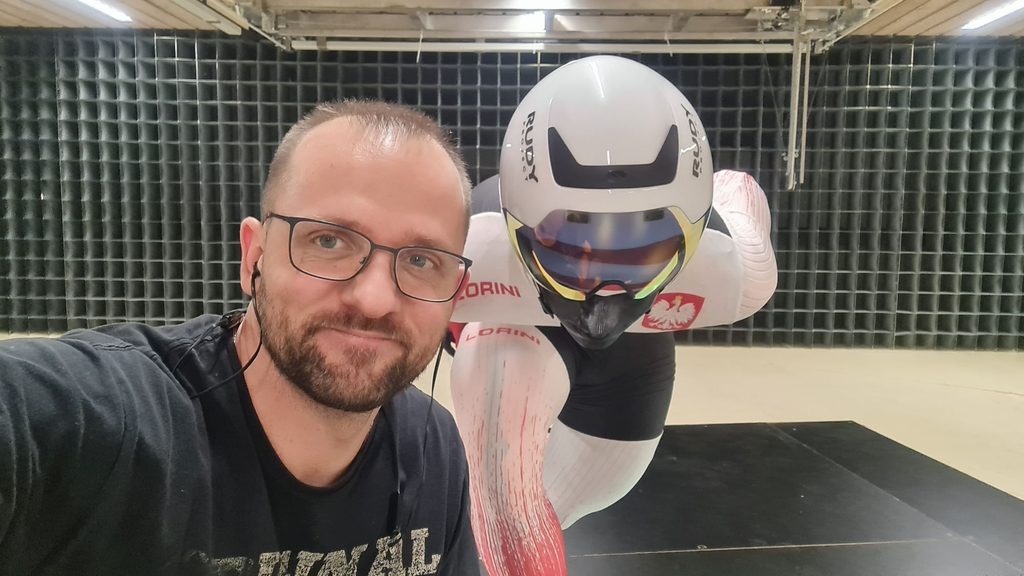
Polish speed skater Władimir Semirunnij won silver medal in the 10,000m event at the 2026 Winter Olympic Games in Italy. His preparation for the race was supported by, among others, aerodynamic research of the skater’s posture and equipment – helmets and suits – conducted at the Environmental Aerodynamics Laboratory of PK Krakow University of Technology (PK KUT). The research, carried out in collaboration with the Polish Speed Skating Association, Alone in Drag company, and the Institute of Sport, was led by Łukasz Flaga, Ph.D. Eng. of Arch., from the PK KUT Wind Engineering Laboratory. For the wind tunnel analyses, life-size mannequins mimicking the skater were created based on 3D scans of his silhouette and characteristic racing positions. This allowed for equipment configuration testing without disrupting the athlete’s training routine.
– “We are thrilled that our engineering expertise and the university’s advanced research facilities could contribute to this success. Of course, an Olympic medal is first and foremost a tremendous achievement of the athlete, his coaching staff, and collaborators, including those from Alone in Drag. However, this example clearly shows that at the highest sporting level, where results are decided by thousandths of a second, science can help shave off that critical time” – says Flaga.
– “We established cooperation with the Polish Speed Skating Association thanks to earlier joint projects with the company Alone in Drag, with whom we worked on, among other things, building a measurement station for track cyclists – recalls Flaga. At the turn of last summer, the PK KUT scientist received an inquiry about the possibility of using the knowledge and research tools of the Wind Engineering Laboratory Team to improve the equipment of a Polish speed skating representative. Time was very limited, but the challenge was undertaken.”
– The research work for the Polish Speed Skating Association involved measurements of the aerodynamic drag of skater Władimir Semirunnij in several characteristic positions, in different suits, and with various equipment, i.e., helmets and goggles (…) In the first stage of the research project, a 3D scan of Władimir was made in his most characteristic positions. Then, “mobilization” was carried out, meaning a digital skeleton was introduced into the 3D model and position elements such as head position, hands, etc. were modified and improved. Based on these files, three mannequins were designed – a steel skeleton and individual body part forms in 3D print. Then we made life-size mannequins and placed them on the test stand in the wind tunnel of the PK KUT Environmental Aerodynamics Laboratory. The most important measuring device here was a 6-component strain gauge balance, an advanced tool for analyzing aerodynamic loads – simultaneously measuring all six load components acting on the tested object, including lift force, drag force, side force, and bending moments – adds Flaga.
The mannequins imitating Władimir Semirunnij’s figure were tested in different suits and – interestingly – in different helmets, although speed skaters do not often compete in them. The Polish representative decided on this piece of equipment during his Olympic start, which distinguished him in Milan among rivals racing with him over 10,000 meters.
– “The athlete and his staff always make final decisions about what to use. In our joint research project, among all the cases we analyzed, we indicated those for which – considering the speed ranges and positions in which he would be moving – the lowest aerodynamic drag was achieved. This positive effect was particularly influenced by the helmet with goggles and the suit – the same ones the athlete wore at the Olympic Games. The helmet alone could make a difference between 0.25 and 0.4 seconds per kilometer” – says Flaga. – “It is worth noting that, for certain positions and speed ranges, the helmet had a negative impact, while for others it was positive. Recommendations from our research work, conducted jointly with specialists from Alone in Drag and the Institute of Sport, were used in training and competition plans. We believe they contributed to winning the medal.”
The results of the research at PK Krakow University of Technology’s laboratory support the continuation of scientific-sports cooperation. – “We are looking forward to it. We have a good starting point for more advanced research already in the perspective of the next Olympic Games. Without scientific support, it is difficult today to achieve success in sports; more and more athletes, coaches, and federations understand this. Just in the last year, Cracow University of Technology has cooperated in the field of aerodynamic research with, among others, the Polish Ski Association, track cyclists, and triathletes: – adds Flaga. For the Polish Ski Association and the Polish ski jumping team, PK KUT engineers conduct, among other things, research on suits.
The Environmental Aerodynamics Laboratory, where research for athletes is conducted, is a globally unique tool for research in the field of wind, snow, and environmental engineering, concerning, among others, city ventilation, pollutant transport, dynamic impact on smog, air exchange and regeneration systems, environmental and climatic impact analyses (such as violent wind, torrential rain, or heavy snow) on structures, buildings, and the safety of people inside them, to name a few. It is also possible to test innovative solutions for wind energy, the building materials and products market, and, among others, solutions supporting the automotive industry (LIDAR systems, aerodynamic packages, etc.). PK KUT’s new research center is also ready to focus on non-standard engineering challenges, including helping athletes or rescue services.