A bio-sponge to stop bleeding: PK Krakow University of Technology researchers develop a natural material that could save lives
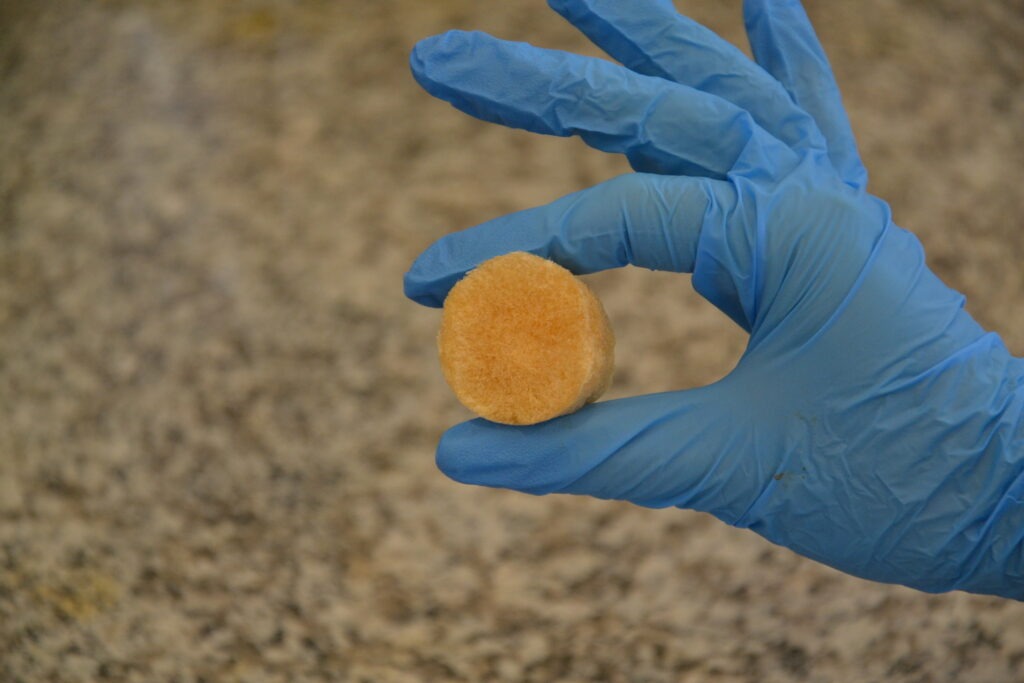
In a severe hemorrhage, every minute can mean the difference between life and death. For such emergencies, researchers at the PK Krakow University of Technology have developed a hemostatic biomaterial that rapidly absorbs blood, helps stop bleeding, reduces the risk of infection and supports the healing of damaged tissue. It takes the form of a porous sponge that anyone, including a person with no professional first-aid training, can easily place even in a deep wound, without complicated procedures or specialist equipment. The technology is based on naturally derived chitosan obtained from fungi. A patent application has been filed, and the material has undergone preclinical testing. It is now being prepared for commercialization through the PRIME program of the Foundation for Polish Science.
In cases of severe bleeding, time is working against the injured person. This applies to road accidents, battlefield injuries and complications during medical procedures alike. A bleeding-control agent must therefore act quickly while being simple enough to use in an emergency, even by someone other than an experienced physician.
This was the premise for the team led by dr inż. Julia Radwan-Pragłowska of the Faculty of Chemical Engineering and Technology at the PK Krakow University of Technology. The researchers set out to create a material that performs several functions at once: it absorbs large amounts of blood, helps stop bleeding, has antibacterial properties, promotes the regeneration of damaged tissue and is non-toxic and safe for the body.
“We did not want to create a material that only stops bleeding. We wanted it to also reduce the risk of infection, support regeneration and be safe for the patient. In the case of a deep wound, the material can be placed inside, perform its function and then gradually degrade naturally,” says dr inż. Julia Radwan-Pragłowska.
Fungal chitosan offers greater functionality than animal-derived chitosan
The solution is based on chitosan, a natural material obtained from chitin, which is then chemically modified using an innovative technology covered by an international patent application. Chitosan is already known for its ability to help stop bleeding, but existing solutions are most often based on animal-derived materials and have limitations. The PK Krakow University of Technology team chose a non-animal source: commonly occurring fungi.
The use of chitosan derived from the cell walls of Aspergillus niger, commonly known as “black mold,” is significant not only for safety and the reduction of potential adverse reactions. It may also be more acceptable to patients who avoid animal-derived products for personal, religious or dietary reasons.
“From the outset, we wanted to use non-animal-derived materials. We want the finished product to be as safe as possible and accessible to a broad range of users. With a medical product, such considerations can make a real difference to patients,” the researcher emphasizes.
Black mold is not the only fungus that can be used to produce the innovative biomaterial. “Mushrooms, for example, can also be used,” says Julia Radwan-Pragłowska.
An easy-to-use sponge that can be placed inside a wound
Initial research into the innovative concept was made possible by funding from a LIDER X grant awarded by the National Centre for Research and Development (project no. LIDER/21/0120/L-10/18/NCBR/2019). The Kraków researchers examined, among other things, the material’s ability to absorb fluid and its interaction with skin cells. The results showed that it was not only non-toxic but could also promote the proliferation of cells involved in tissue repair.
The biomaterial can take various forms, including powder or granules. However, a three-dimensional, highly porous sponge attracted the greatest interest in discussions with medical professionals, for a practical reason. In a deep wound, the sponge can be placed exactly where the bleeding is occurring. Its placement creates a physical barrier, after which the material begins to absorb blood and help stop the bleeding.
“In an emergency, simplicity is essential. The injured person may be in shock, their hands may be shaking, and they may be under enormous pressure. The material should therefore be intuitive to use: take it out of the packaging and place it directly at the site of bleeding. It should not require complicated preparation or highly precise handling,” explains dr inż. Radwan-Pragłowska.
This may be particularly important in tactical medicine. A wounded soldier or someone assisting them cannot always prepare a dressing under calm conditions. In such circumstances, powder can spill or be applied in the wrong place. A lightweight sponge is easier to carry and use and does not stick during application.
“We want this solution to be useful both to a physician in a treatment room and to someone who has to administer first aid in very difficult conditions. In battlefield medicine or during police or firefighting operations, being able to treat a wound quickly and independently can make an enormous difference before the injured person receives professional medical care,” the researcher adds.
Material developed at the PK Krakow University of Technology has undergone preclinical testing
The project is considerably more advanced than an idea tested only in a test tube. Following cell studies, the researchers moved on to preclinical studies using a large animal model, funded by the LIDER X project. After approval by the local ethics committee, the studies were conducted under a subcontract at the University of Agriculture in Krakow by dr hab. inż. Tomasz Schwarz, prof. URK, who designed the experiment, dr hab. inż. Maciej Murawski of the same university and dr hab. n med. Klaudia Stangel-Wójcikiewicz, prof. UJ
The material was tested on both superficial wounds and much more serious injuries causing severe bleeding. The researchers assessed not only its effectiveness in stopping bleeding but also the safety of prolonged contact between the biomaterial and the body. At one stage, it remained inside the body for more than a month.
“It was essential to test the material under conditions as close to real life as possible. The fact that something absorbs fluid well in the laboratory does not necessarily mean it will cope with an actual hemorrhage. Preclinical studies allowed us to confirm both its effectiveness in different types of wounds and the safety of leaving it inside the body,” says dr inż. Radwan-Pragłowska.
Next steps: tests using volunteer blood, certification and a new company
One important stage of research still lies ahead. The scientists are preparing tests using blood drawn from healthy volunteers. These will be possible thanks to funding secured through the Science4Business project, implemented with EU funding by the PK Krakow University of Technology’s Technology Transfer Centre. The tests are intended to help fully characterize the material’s mechanism of action and complete the documentation needed for the next steps toward certification. The solution can only be marketed as a medical device once the appropriate certificate has been obtained.
The team also plans to establish a company responsible for the further development and commercialization of the technology. It will build on the existing research documentation, know-how and patent applications of the inventors: dr inż. Julia Radwan-Pragłowska, dr inż. Łukasz Janus, mgr inż. Aleksandra Sierakowska-Byczek and mgr inż. Klaudia Kuźmiak. Thanks to the Patent Cooperation Treaty (PCT) procedure already initiated by the university, the invention may also receive international patent protection, including in the United States.
“Our goal was never simply to publish our findings and put them on a shelf. We want to create an actual medical device. We now need to complete the final studies, prepare the full documentation and establish a company that can take the technology through the remaining stages to market. The most important task is product certification,” the researcher emphasizes.
From the battlefield to the dental office
The team’s scientific leader is preparing to commercialize the solution in part through participation in the Foundation for Polish Science’s PRIME program. This knowledge and technology transfer accelerator program is designed for researchers and research organizations. Participants develop commercialization skills, hold discussions with prospective users and prepare individual pathways for bringing their technologies into use.
Participation in the program helped the PK Krakow University of Technology team determine which product applications and markets would be the best starting point for commercialization. The innovators are currently focusing primarily on tactical medicine and dentistry. In dentistry, hemostatic agents are regularly used during procedures such as tooth extractions and implant surgery. The private dental market’s openness to new solutions is an additional advantage.
“Above all, PRIME taught us to test our assumptions against what the market actually expects. As researchers, we may be convinced that we know who needs our product most. Only by talking to a prospective user can we see where the solution has the best chance of initial adoption and what still needs to be changed,” says Julia Radwan-Pragłowska.
A researcher, a physician, and technology transfer and business experts on one team
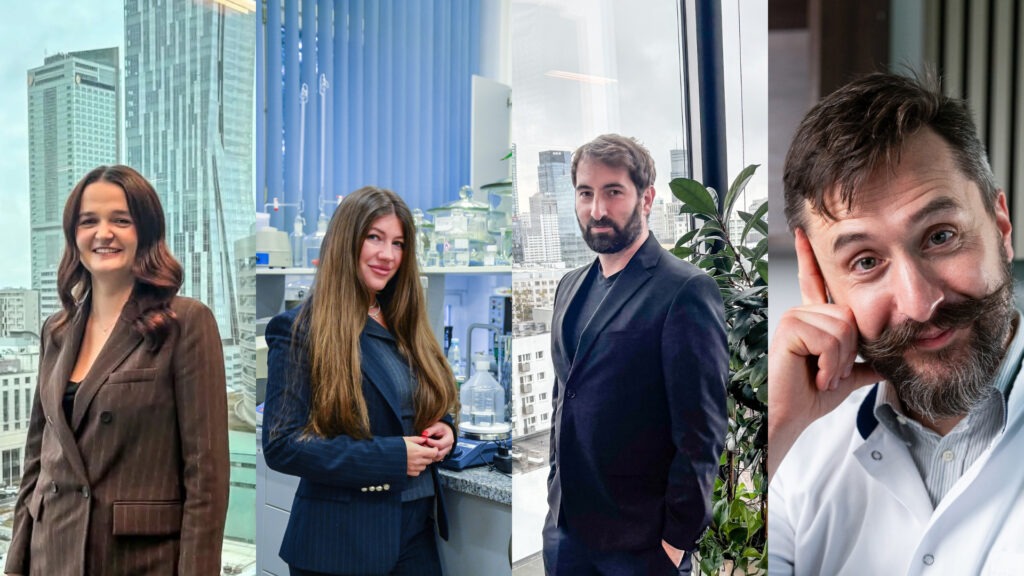
In the PRIME project, dr inż. Julia Radwan-Pragłowska serves as scientific leader. She works with Joanna Szypułka, an expert from the PK Krakow University of Technology’s Technology Transfer Centre, and Andrzej Woźniacki, the business leader, who specializes in applying AI and machine learning to medical data analysis. Joanna Szypułka is responsible, among other things, for preparing the transfer of a license for the solution from the university to the future company. Andrzej Woźniacki handles the business plan, funding sources, product valuation and development of a market entry strategy.
“With the support of specialists in technology transfer and its commercial application, I can focus on the science and certification while the entire project moves toward practical implementation,” emphasizes dr inż. Radwan-Pragłowska.
Participation in PRIME also reinforced the researcher’s decision not to limit her involvement to licensing the solution to an external company, but to take an active part in its further development. To this end, she plans to establish a company with technology co-inventor dr inż. Łukasz Janus, business expert Andrzej Woźniacki and principal investigator dr n. med. Paweł Potocki. The company will apply for funding under Phase III of the PRIME project to begin work toward certification of the medical device.
Dr n. med. Paweł Potocki is an oncologist affiliated with Jagiellonian University who specializes in gastrointestinal, urinary tract and breast cancers. He has served as an investigator in more than 40 clinical trials and is a member of ASCO, ESMO and PTOK. “Adding such an experienced clinical research expert to the team will significantly increase the chances of bringing this innovative solution into use and strengthen the expertise of our entire team,” says Julia Radwan-Pragłowska.
If all subsequent stages of development are successful, the biomaterial developed in Kraków could become part of the equipment used by paramedics, police officers, firefighters and soldiers, as well as being used in dental offices. In each setting, its purpose will be the same: to give the user a simple way to quickly reduce bleeding when every minute counts.
Research and commercialization funded through several projects
The solution developed by researchers at the PK Krakow University of Technology is covered by a patent application entitled “Method for producing a bifunctional chitosan-based biomedical material and material produced by this method” (no. P.453618 of October 31, 2025, and PCT no. PCT/IB2026/061764 of October 31, 2026).
Work on the solution is being carried out through several projects:
1. LIDER project entitled “BioHemPro – personalized bifunctional hybrid matrices with induced bioactive properties as innovative hemostatic systems,” agreement no. LIDER/21/0120/L-10/18/NCBR/2019, National Centre for Research and Development (NCBR); funding: PLN 1,409,375.00.
2. PRIME project entitled “Defining a commercialization pathway for advanced chitosan-based hemostatic biomaterials for medical applications,” no. PRIME 02.06-0143/25, Foundation for Polish Science; PLN 313,904.00. The PRIME project is financed by the European Funds for a Modern Economy program (FENG).
3. Science4Business minigrant entitled “BioHemPro – validation of a hemostatic biomaterial in a medical experiment,” Development Incubator; funding: PLN 80,000.
In all projects, dr inż. Julia Radwan-Pragłowska of the Faculty of Chemical Engineering and Technology at the PK Krakow University of Technology is the project leader, sole author and originator. The principal project team members are dr inż. Łukasz Janus and mgr inż. Aleksandra Sierakowska-Byczek of the PK Krakow University of Technology. The principal investigator in the Science4Business project is dr n. med. Paweł Potocki, who is responsible for conducting studies using blood from healthy volunteers following approval by the bioethics committee.
(m/fnp)