PK Krakow University of Technology has established its own academic security service, University Guard, responsible for maintaining safety and order across the university’s campuses. Officers are present on-site at all times, allowing for a faster and more effective response than external security firms could provide — for example, in cases of theft, fights, or acts of vandalism. The academic security service operates on the principles of prevention and support, with full respect for the rights of the entire university community. Its role is to respond to incidents and to help build a sense of safety on campus for students, staff, and visitors.
In an Emergency
- Call the emergency number 112
- Notify the nearest reception/porter’s lodge (portiernia)
- Provide first aid if needed
- Use the first aid kit available at every reception/porter’s lodge, or the automated external defibrillator (AED), if necessary
Contact Numbers
Fire Safety, Security and Defence Affairs Team (with the academic security service):
Tel.: +48 12 628 25 50, +48 12 628 25 20
Reception/Porter’s Lodges (Portiernie):
- Faculty of Civil Engineering: +48 12 628 22 99
- Faculty of Chemical Engineering and Technology: +48 12 628 27 99
Reporting a Direct Threat to Health or Life
If a direct threat to health or life occurs on university premises, report it immediately:
- 7:00 AM–3:00 PM: call +48 12 628 22 23 or e-mail bhp@pk.edu.pl
- After 3:00 PM: call +48 12 628 22 99 (main reception, ul. Warszawska 24) or +48 12 628 22 89 (main gate / security post, ul. Warszawska 24)
Guidance documents:
Lists of staff trained in first aid, by campus:
- Warszawska Street campus
- Czyżyny campus
- Podchorążych Street
- Student Housing Estate
- Juliusza Lea Street
- Kanonicza Street
- Bydgoska Street
Automated External Defibrillators (AEDs) at PK KUT
An Automated External Defibrillator (AED) is a highly specialized, reliable, computerized device that guides the person providing first aid through the safe defibrillation procedure using voice prompts, for a casualty whose heart has stopped. An AED can be used by anyone who witnesses a cardiac arrest requiring resuscitation — around 70% of adult cardiac arrests result from a heart attack. Its simple operation means that even people without medical training can use it to save a life.
The device combines digital signal processing with advanced ECG analysis algorithms: it first analyzes the heart’s rhythm, and only then — if necessary — delivers a life-saving defibrillation shock, ensuring that the shock is applied correctly. The electrical pulse, at around 250 J, passes between the electrodes attached to the casualty’s body and is designed to stimulate the heart muscle to resume normal function.
Statistics show that cardiopulmonary resuscitation combined with defibrillation within 3–5 minutes of collapse can result in successful resuscitation in 49–75% of cases, while each additional minute of delay reduces the chance of survival by 10–12%.
The device is simple enough to operate that basic instructions can be learned from a step-by-step visual guide or a demonstration video. In addition, PK staff receive AED training as part of the first aid module during initial occupational health and safety (OHS) training.
AED Locations at PK Krakow University of Technology
- Faculty of Civil Engineering building, at the main entrance from ul. Warszawska 24 (next to the reception)
- Faculty of Chemical Engineering and Technology building (entrance from ul. Szlak, at the reception)
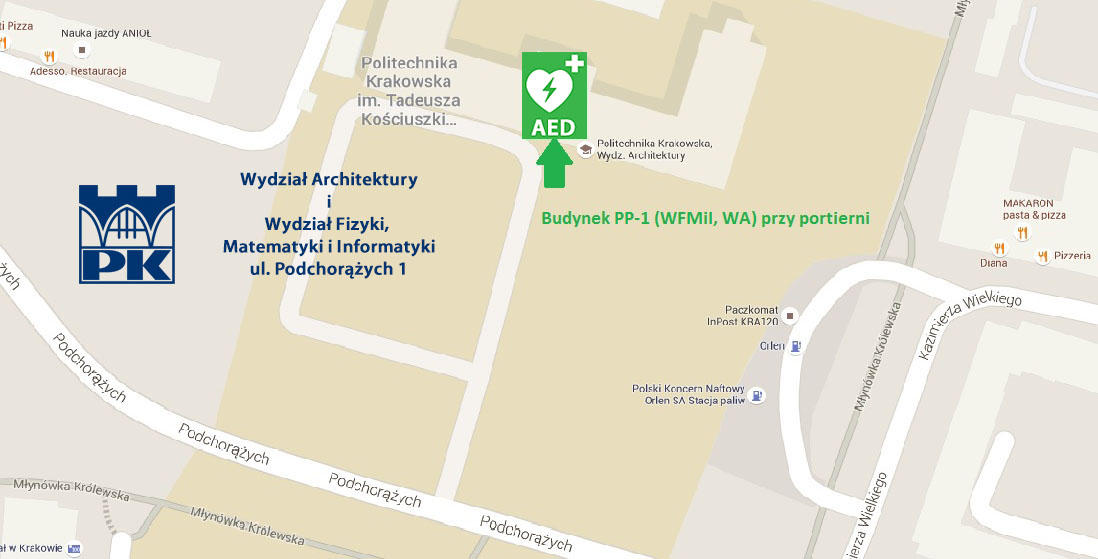
- Faculty of Architecture and Faculty of Physics, Mathematics and Computer Science building, ul. Podchorążych 1 (at the reception)
- Faculty of Architecture building, ul. Kanonicza 1 (at the reception)
- Student Housing Estate in Czyżyny: Student Dormitory No. 2 “Leon” (at the reception) and Student Club “Kwadrat” (at the reception)
- Czyżyny Campus: Centre for Training and Quality Systems Organization (entrance opposite the reception), and Faculty of Mechanical Engineering buildings A (reception) and D (at the entrance), al. Jana Pawła II 37
- PK Sports and Recreation Centre, ul. Kamienna (at the reception)
First Aid Guide
Your own safety comes first. Secure the scene of the accident and call for help.
1. Assess the casualty and call the emergency number 112.
2. Check for consciousness:
- Try to make contact with the person.
- If they do not respond, gently shake their shoulder.
3. If the casualty does not respond, open the airway:
- Place one hand on the casualty’s forehead and the other under their chin, then carefully tilt the head back.
4. Check breathing:
- Keep the head tilted back with one hand.
- Place your other hand on the chest.
- Observe breathing for 10 seconds — you should see 2 breaths.
5. Call for medical help (112) and begin appropriate care.
Unconscious — Breathing
Place the casualty in the recovery position:
- Bend the arm nearest to you at a right angle, with the palm facing upward (the “Hello position”).
- Place the casualty’s other hand across their chest, with the back of the hand against their cheek.
- Grasp the far leg under the knee.
- Pull, bending the knee, and roll the person onto their side, facing you.
- Tilt the head back to keep the airway open.
- Check breathing every minute.
- Keep the person warm and comfortable.
Wait for the ambulance to arrive. Do not leave the casualty unattended.
Unconscious — Not Breathing
Begin resuscitation (CPR):
- Place the person on a firm, stable surface.
- Expose the chest.
- Place the heel of one hand in the centre of the chest.
- Place your other hand on top and interlock your fingers.
- Lean over the casualty with your arms straight.
- Compress the chest without lifting your hands off the sternum, at a rate of 100–120 compressions per minute, to a depth of approximately 5–6 cm.
Using an AED:
- Ask someone to bring an AED as quickly as possible, if one is available nearby.
- Take the AED out of its case and press the green button.
- Follow the device’s voice instructions.
Wait for the ambulance to arrive. Do not leave the casualty unattended.